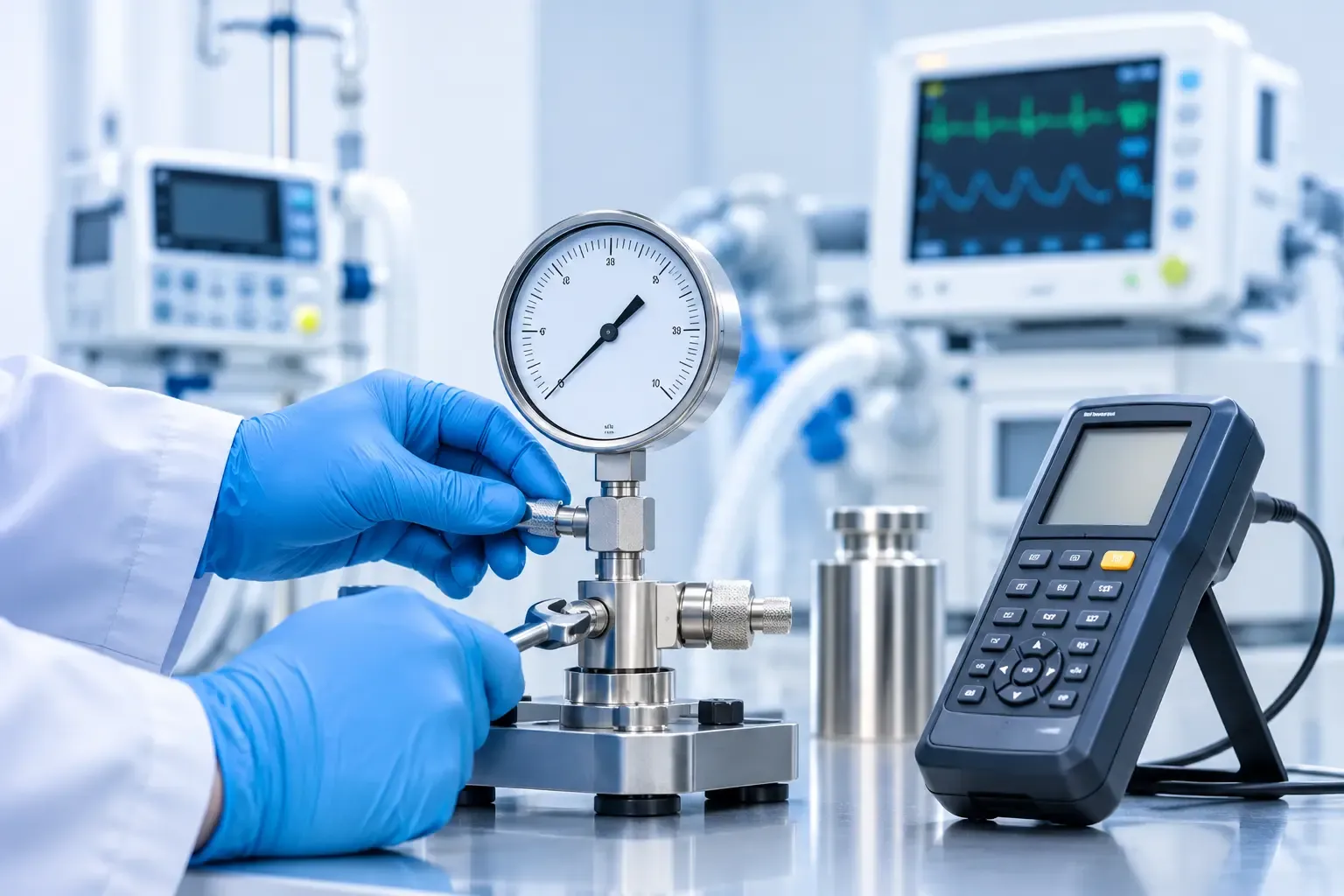
When a company makes medical devices, the measurements taken on the production line are part of the device's safety case. The torque on a screw in a surgical instrument, the force needed to pull a catheter connection apart, the temperature a heat sealer reaches on a sterile pouch, the pressure in a leak test: every one of these supports a claim that the device is safe and works as intended. If the measuring instrument is wrong, the claim is not supported, no matter how good the process looks on paper.
That is why calibration for ISO 13485 medical device manufacturers in the UAE gets close attention from auditors, notified bodies and customers. This guide explains what ISO 13485 expects from calibration, which instruments carry the most risk in medical device manufacturing, how to handle out-of-tolerance findings, and how to keep records ready for inspection.
What ISO 13485 Requires
ISO 13485:2016 is the quality management standard for medical device organizations, and its clause on the control of monitoring and measuring equipment is explicit. In summary, an organization must:
- Determine the monitoring and measurement to be done and the equipment needed to provide evidence that products conform
- Calibrate or verify measuring equipment at specified intervals, or before use, against measurement standards traceable to international or national standards. Where no such standards exist, the basis used for calibration or verification must be recorded
- Adjust or re-adjust equipment as necessary
- Identify equipment so its calibration status can be determined
- Protect equipment from adjustments that would invalidate results, and from damage during handling and storage
- When equipment is found not to conform, assess and record the validity of previous measurement results and take appropriate action on both the equipment and any affected product
- Keep records of calibration and verification results
- Validate software used for monitoring and measurement before initial use and re-confirm it as appropriate
Regulatory frameworks build on this. For example, the US FDA's quality system regulation, which now incorporates ISO 13485 by reference, and EU medical device regulation both expect calibrated, controlled measuring equipment. Check which frameworks apply to your products and markets.
Why Medical Devices Raise the Stakes
Compared with general manufacturing, medical device production has features that tighten expectations:
- Patient risk. A nonconforming device can harm a patient, so measurement errors have direct consequences
- Process validation. Many processes, such as sterilization and sealing, cannot be fully verified by testing the finished product, so they are validated and then controlled by monitoring critical parameters with calibrated instruments
- Regulatory scrutiny. Auditors examine calibration records closely, and as-found data and impact assessments are standard questions
- Traceability to batches. If an instrument fails, you need to know exactly which lots were affected
The Instruments That Matter Most
Torque and Assembly Tools
Torque drivers and wrenches control the tightness of screws and fittings in assembled devices. Overtightening can crack parts, and undertightening can cause failures in use. See our guide to torque wrench calibration.
Force and Pull Test Equipment
Bond, peel and pull tests verify that joints and connections hold. Force gauges, test stands and load cells need accurate calibration for these results to mean anything. See our guides to force gauge calibration and load cell calibration.
Dimensional Measurement
Medical devices often have small features and tight tolerances, so micrometers, calipers, gauges, optical systems and CMMs must be accurate. See our guides to dimensional calibration and CMM calibration.
Temperature, Sealing and Sterilization Equipment
Heat sealers, ovens, autoclaves and sterilization equipment depend on temperature, pressure and time being controlled within validated limits. For sterile barrier packaging, seal integrity depends on correct sealing temperature, pressure and dwell time, so the instruments verifying them must be calibrated. See our guides to temperature calibration and temperature data logger calibration.
Pressure and Leak Testing
Leak and pressure decay tests, and process pressures, rely on pressure gauges and transducers. See our guide to pressure gauge calibration.
Cleanroom and Environmental Monitoring
Controlled environments depend on temperature, humidity and differential pressure instruments to demonstrate that room conditions stay within limits. See our guides to humidity calibration and manometer calibration.
Balances and Laboratory Instruments
Weighing, pH and volumetric instruments support formulation, cleaning validation and quality control testing. See our guides to mass calibration and pH meter calibration.
Electrical Safety Test Equipment
Devices that connect to power or patients are typically tested for electrical safety before release, using electrical safety analyzers and related instruments. Those test instruments need their own calibration so safety test results can be trusted.
Risk-Based Calibration Control
ISO 13485 organizations normally approach calibration by risk. A practical method:
- Identify critical measurements. Which measurements demonstrate conformity of the device or control a validated process?
- Classify the instruments. Critical, supporting or reference only, with the reasoning documented
- Set intervals and tolerances from the process, not just the manufacturer. The tolerance must reflect what the process needs
- Calibrate against traceable standards and keep certificates
- Review intervals using as-found history
Our guide to calibration frequency in the UAE explains how to set and review intervals.
Out-of-Tolerance Findings: The Impact Assessment
The standard requires assessing and recording the validity of previous measurements when equipment is found not to conform. In practice:
- Remove the instrument from use and identify the date of its last good calibration
- Determine which lots, processes and inspections used it since then
- Judge whether the error was large enough to cause an incorrect accept or reject decision
- Take action on affected product and document the conclusion, using your nonconformance and corrective action procedures
- Correct or replace the instrument and recalibrate
This is only possible with as-found data, so choose a calibration provider whose certificates report as-found and as-left results, uncertainty and traceability.
Calibration Software and Records
If you use software to manage calibration records, or software that is part of a measurement system, ISO 13485 expects it to be validated for its intended use. Keep a controlled instrument register, unique IDs, status labels, retained certificates and records of intervals and their rationale. Our guide to how to get a calibration certificate in the UAE explains what a reliable certificate contains.
Choosing a Calibration Provider
For a medical device manufacturer, look for:
- Accreditation to ISO/IEC 17025 covering the disciplines and ranges you use
- As-found and as-left data, measurement uncertainty and traceability on every certificate
- Calibration points and tolerances aligned with your validated processes
- On-site capability for fixed equipment such as sealers, chambers and test rigs
- Reliable turnaround so critical equipment is not out of service for long
Our laboratory is accredited by EIAC (LB-CAL-004) and ENAS (NAL 240) across 15 disciplines. See our full range of calibration disciplines and on-site calibration option.
Frequently Asked Questions
What does ISO 13485 say about calibration? It requires measuring equipment to be calibrated or verified at specified intervals against standards traceable to national or international standards, identified for status, protected from invalidating adjustment, and assessed for impact on past results if found out of tolerance.
Do medical device manufacturers need accredited calibration? ISO 13485 requires traceability but doesn't name accreditation. Accredited ISO/IEC 17025 certificates are the usual way to demonstrate it and are often expected by auditors and customers.
Why does as-found data matter for medical devices? It lets you assess which lots and measurements were affected by an out-of-tolerance instrument, which the standard requires you to evaluate and record.
Which instruments are most critical? Torque tools, force test equipment, dimensional instruments, temperature and pressure equipment for sealing and sterilization, cleanroom monitoring instruments and electrical safety testers.
Does calibration software need validation? Where software is used for monitoring and measurement, ISO 13485 expects it to be validated for its intended use before initial use and re-confirmed as appropriate.
Closing Thoughts
Calibration for ISO 13485 medical device manufacturers in the UAE is about proving that every measurement supporting a device's safety is trustworthy. Classifying instruments by risk, setting tolerances from validated processes, keeping as-found data and using an accredited provider turns calibration into a core part of a defensible quality system.
To discuss calibration for your medical device production, reach out through the General Tech Services contact page.