A scale reading half a gram off sounds negligible until it's weighing pharmaceutical ingredients, verifying shipping weights for customs declarations, or confirming a calibration weight used to check every other balance in a facility. Mass measurement sits underneath more processes than people usually realize, and unlike a visual defect, a miscalibrated scale gives no outward sign anything is wrong.
This is exactly why mass calibration UAE laboratories, manufacturers, and logistics operations depend on needs proper accreditation and the right reference standards for each specific weight class involved. This guide covers how mass calibration actually works, what the different weight classes mean, and what to expect from a properly run mass calibration program.
How Mass Calibration Actually Works
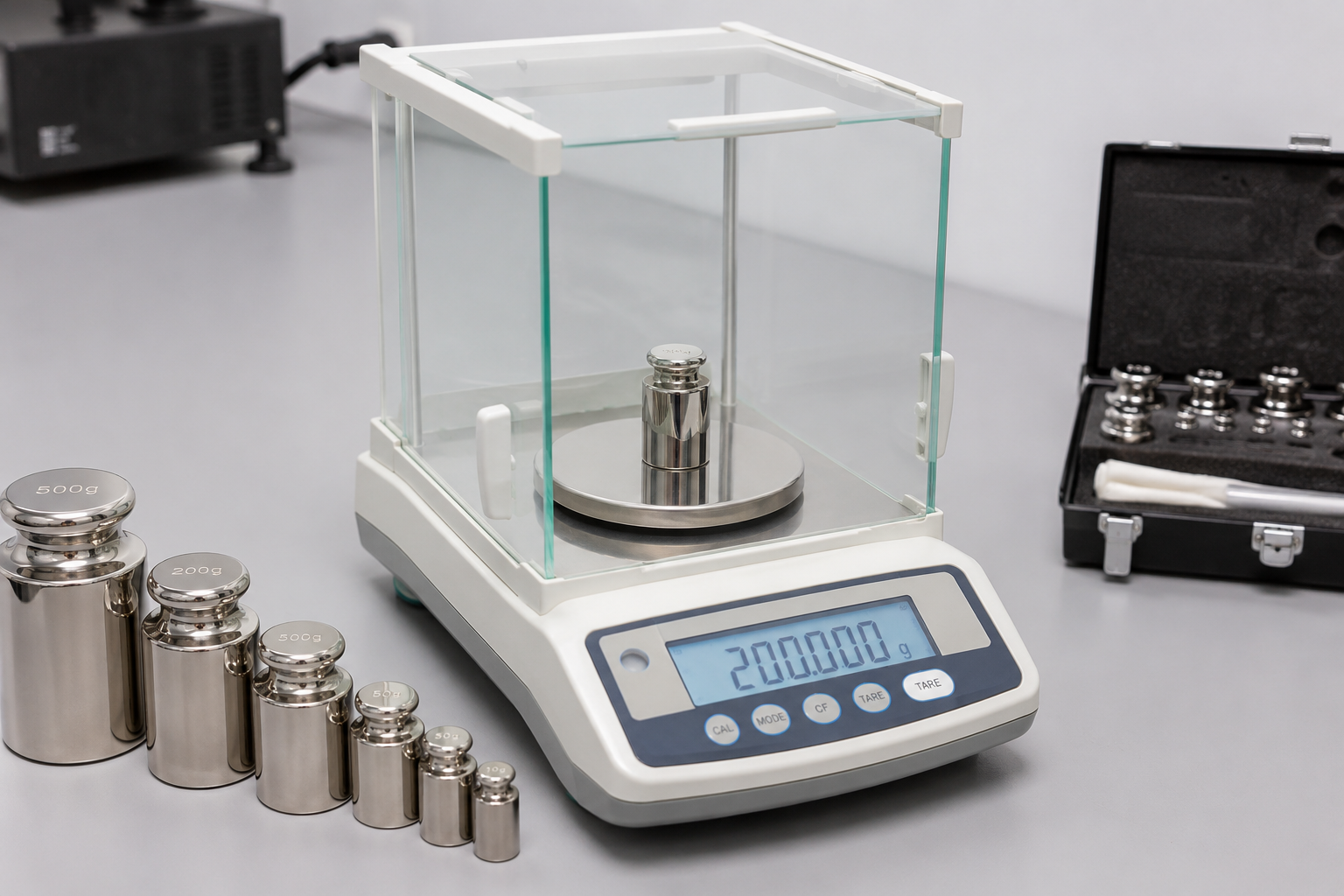
Mass calibration entails a weight comparison from the scale readout against a known standard or mass value. In practice, this means placing a precision mass standard of known, traceable accuracy onto a balance or scale, and comparing the instrument's displayed reading against that known value. Any deviation is recorded, and depending on the instrument and its intended use, the balance may be adjusted to correct the discrepancy or the deviation simply documented for the end user's reference.
This principle sounds straightforward, but the practical execution varies considerably depending on what's actually being calibrated:
Balance Calibration
Analytical and precision balances used in laboratory settings typically require the tightest accuracy verification, often tested using multiple mass points across the balance's weighing range rather than a single reference weight, since accuracy can vary meaningfully between low and high points on a balance's scale.
Scale Calibration
Industrial scales and platform scales, often handling much larger capacities than laboratory balances, require correspondingly larger reference mass standards. Specialized labs are equipped with equipment capable of performing scale calibration on test items with capacities over 1,000 lbs, extending well beyond what typical laboratory calibration setups can accommodate.
Comparator Calibration
Mass comparators, precision instruments specifically designed to compare two mass standards against each other with extremely fine resolution, require their own calibration process distinct from general balance calibration, given how much more sensitive they typically are than a standard weighing balance.
Weight Calibration
The calibration weights themselves, used as reference standards for calibrating balances and scales, need their own periodic calibration and traceability, since an inaccurate reference weight would silently propagate its error into every instrument calibrated against it.
Understanding Weight Classes: Why They Matter
One of the more technical aspects of mass calibration is understanding the classification system governing calibration weights. Weight calibration is available for a wide range of classes, including A, B, C, F, M, P, Q, S, S-1, T, 1, 1.1, 2, 3, 4, 5 and 6, as defined in specifications including NBS Handbook 105-1 and 44, NBS Circular 547, and ANSI/ASTM E617.
Broadly, these classes fall along a spectrum:
- The highest precision classes, such as Class 1, serve as reference standards themselves, suitable for calibrating other weights and appropriate for high-precision analytical balances with readability as fine as 0.01 milligrams
- Mid-range classes support calibration of precision top-loading balances used in general laboratory work
- Lower precision classes, including Class F designations, are primarily used to test commercial weighing devices, the kind of scales used in everyday commercial transactions where goods are sold by weight
- The coarsest classes suit rough weighing operations where extreme precision isn't the priority
Selecting the correct weight class for a given application matters just as much as the calibration process itself. Using a lower-precision weight class to calibrate a high-precision analytical balance undermines confidence in that balance's results regardless of how carefully the calibration was performed.
Wheel Weighing Scale Calibration
Beyond standard laboratory and industrial scales, wheel weighing scale calibration addresses a distinct application: verifying scales used to measure axle or wheel loads on vehicles, relevant for transportation compliance, load distribution verification, and vehicle safety inspection. These scales require calibration against known reference masses positioned to simulate actual wheel loading conditions, a different setup than calibrating a standard platform or bench scale.
DAC Accreditation: What It Confirms
Mass calibration accredited by the Dubai Accreditation Centre, commonly referred to as DAC, means the laboratory's mass calibration competence has been independently assessed against recognized international standards. Calibration standards used in this process are traceable to national standards, giving the resulting certificates the defensible weight needed for audit and compliance purposes across pharmaceutical, laboratory, and industrial applications where mass accuracy directly affects product quality or regulatory compliance.
Why Climate-Controlled Conditions Matter for Mass Calibration
Precision mass calibration is typically performed in a climate-controlled facility, and this isn't a minor operational detail. Temperature affects the density of air, which in turn affects buoyancy forces acting on both the reference mass and the item being weighed, introducing measurable error at the level of precision high-accuracy mass calibration demands. Humidity can also affect mass measurements, particularly for reference weights that may absorb minute amounts of moisture. A laboratory maintaining stable environmental conditions throughout the calibration process protects the fine-grained accuracy that mass calibration, especially at the higher precision weight classes, genuinely requires.
On-Site vs In-Lab Mass Calibration
Not every scale can be practically removed for calibration. Some instruments can also be calibrated on-site at customer facilities by specially trained field technicians, particularly relevant for large industrial scales, platform scales integrated into a production line, or wheel weighing scales that are impractical to transport. Smaller precision balances, particularly those requiring the tightest accuracy verification, generally benefit from in-lab calibration under fully controlled environmental conditions.
Our full range of ISO 17025 accredited calibration disciplines covers mass calibration alongside pressure, temperature, dimensional, and electrical measurement, giving facilities running mixed equipment fleets a single accredited provider across categories.
What a Mass Calibration Certificate Should Include
A properly issued mass calibration certificate should clearly document:
- The specific instrument or weight identification, including its stated class or capacity
- Measurement results at each tested point compared against the reference standard
- Stated tolerance and pass or fail status
- The measurement uncertainty associated with the calibration
- Traceability details for the reference mass standards used
- The accreditation body and standard the issuing laboratory operates under
A well-run calibration program should also include a due-date reminder system, alerting customers when an instrument is approaching its next recalibration date rather than leaving that tracking entirely to the customer's own internal records.
How Often Should Mass Instruments Be Calibrated
General guidance for calibration frequency includes:
- Annual calibration as a standard baseline for balances and scales in general laboratory or industrial use
- More frequent calibration for reference-grade calibration weights used to verify other instruments, given how directly their accuracy propagates through everything calibrated against them
- Immediate recalibration after any suspected damage, drop, or unusual measurement inconsistency
- Verification following relocation of a scale or balance, since some instruments are sensitive to changes in mounting or leveling conditions
Frequently Asked Questions
What's the difference between balance calibration and scale calibration? Balance calibration typically refers to precision laboratory instruments verified across a fine measurement range, often at multiple points, while scale calibration generally covers larger-capacity industrial or platform scales, sometimes handling capacities over 1,000 lbs, using correspondingly larger reference mass standards.
Why do calibration weights come in so many different classes? Different classes correspond to different accuracy requirements, from Class 1 reference-grade weights suitable for calibrating other weights and high-precision analytical balances, down through classes intended for commercial weighing devices and general rough weighing operations. Matching the right class to your specific instrument's precision requirement is essential.
Does mass calibration need to happen in a climate-controlled environment? For high-precision applications, yes. Temperature and humidity affect air density and buoyancy forces acting on both reference weights and the item being measured, introducing error that matters at the fine accuracy levels precision mass calibration demands.
Can large industrial scales be calibrated without removing them from service? Yes, in many cases. On-site calibration by trained field technicians is commonly available for large industrial scales, platform scales, and wheel weighing scales that are impractical to transport to a laboratory.
What does DAC accreditation mean for a mass calibration certificate? DAC, the Dubai Accreditation Centre, independently assesses a laboratory's mass calibration competence against recognized standards, giving certificates from an accredited lab defensible standing for audits and regulatory compliance that an unaccredited calibration cannot offer.
Closing Thoughts
Mass calibration UAE laboratories, manufacturers, and logistics operations depend on protects the accuracy underlying a surprisingly wide range of processes, from pharmaceutical formulation to commercial weighing to the reference weights used to verify every other balance in a facility. Whether calibrating a high-precision analytical balance or a large-capacity industrial scale, matching the correct weight class to the application and working with a DAC-accredited, climate-controlled laboratory is what keeps that accuracy defensible.
To schedule mass or broader industrial calibration across the UAE, reach out through the General Tech Services contact page, or explore the complete range of ISO 17025 accredited calibration disciplines available across the UAE.