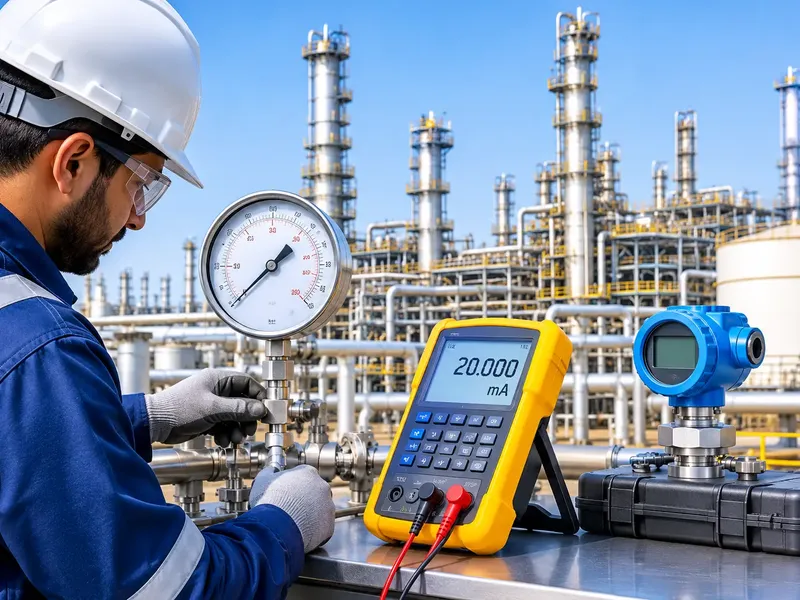
Some instruments can't go to a laboratory. They are bolted into a production line, fixed in a plant room, too large to lift, too critical to remove, or simply too expensive to leave without for several days. For those, the laboratory has to come to the instrument.
This guide explains how on-site calibration across all 7 Emirates works with General Tech Services: what technicians bring, what can and can't be calibrated at your site, how to prepare, and what documentation you should expect afterward. It applies whether your facility is in Dubai, Abu Dhabi, Sharjah, Ajman, Ras Al Khaimah, Fujairah or Umm Al Quwain.
What On-Site Calibration Means
On-site calibration means a technician travels to your facility with calibrated reference standards and performs the calibration where the instrument is installed or used. Instead of removing the instrument, shipping it, waiting and reinstalling it, the calibration happens in place, often while operations continue around it.
It is not a lesser form of calibration. When done properly, it follows the same logic as laboratory work: compare the instrument against a more accurate traceable reference, record the results, and document uncertainty and traceability. Our on-site service is delivered under our ISO/IEC 17025 quality system, with accreditation from EIAC (LB-CAL-004) and ENAS (NAL 240).
How We Cover All Seven Emirates
Our accredited laboratory is in Industrial Area 11, Sharjah, and we maintain an office in Abu Dhabi. Our on-site capability is supported by a fleet of more than 20 service vehicles and a team of more than 60 qualified engineers, which lets us serve customers across all seven Emirates: Dubai, Abu Dhabi, Sharjah, Ajman, Ras Al Khaimah, Fujairah and Umm Al Quwain.
Coverage works in two modes:
- On-site visits, where technicians bring reference standards to your facility
- Laboratory calibration, where portable instruments go to our Sharjah laboratory, with collection arrangements available. Ask us about this when booking
Many customers use both, so the question is not on-site or lab but which instruments belong in which group. Our guide to on-site versus in-lab calibration explains how to decide.
Which Instruments Suit On-Site Calibration
On-site calibration is most valuable for instruments that are fixed, large, critical or disruptive to remove. Typical examples include:
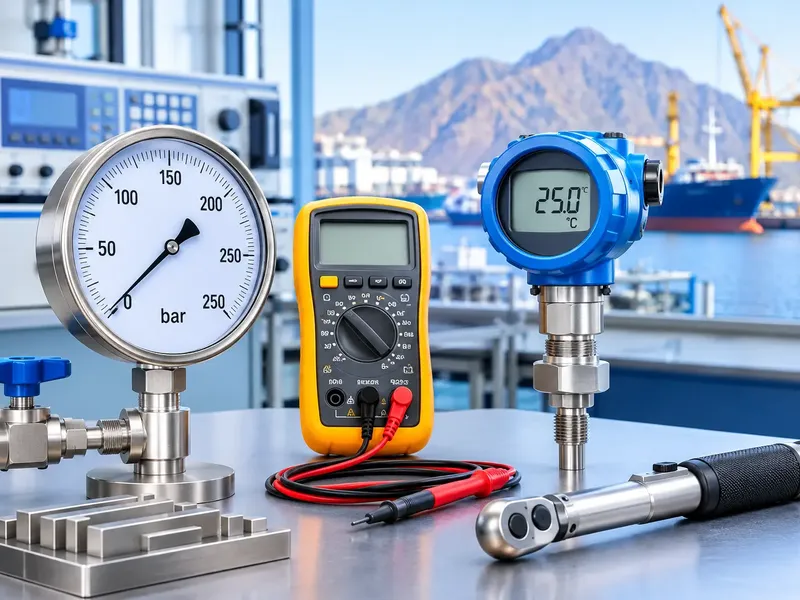
- Installed pressure and temperature instruments, such as transmitters, gauges and sensors in pipework and plant
- Furnaces, ovens, chambers and cold rooms, where the equipment itself or its sensors must be verified in place
- Large scales, weighbridges and balances that are difficult to move
- Flow meters installed in pipelines
- Materials testing machines and force measuring systems
- Gas detection systems, fixed and portable, in plants and hazardous areas
- Electrical test equipment and panel instruments on large installations
- Instruments in sensitive environments such as cleanrooms and hospitals, where moving equipment is awkward
Smaller portable instruments such as multimeters, calipers and hand gauges are often better calibrated in the laboratory, where conditions are tightly controlled.
What Can Limit On-Site Calibration
On-site calibration is practical but has limits, and understanding them helps set expectations:
- Environmental conditions. A plant floor is less controlled than a laboratory, and temperature, vibration, dust and drafts can affect precise measurements. For very high-accuracy work, the laboratory is often better
- Access and safety. Permits, isolations, confined spaces or hazardous areas may restrict what can be done and when
- Reference equipment transport. Some standards are large, delicate or hard to move, which affects what can be done on site
- Instrument condition. If an instrument needs repair or major adjustment, it may need to go to a workshop
A good provider will tell you honestly when an instrument is better calibrated in the laboratory. Confirm which of your instruments and ranges can be handled on-site, and which fall within the accredited scope for on-site work.
How On-Site Calibration Works Step by Step
- Scope and booking. You provide a list of instruments with make, model, range and location, and we confirm what can be done on-site and plan the visit
- Preparation. We agree access, permits, safety requirements and any isolation or shutdown needed
- Mobilization. Technicians arrive with calibrated reference standards, carrying their own certificates and traceability
- As-found check. Each instrument is tested as it stands, before any adjustment
- Adjustment, if needed and possible. Where the instrument can be corrected in place, it is adjusted and rechecked
- As-left check. Results after adjustment are recorded
- Labeling and documentation. Instruments are labeled and certificates are issued with results, uncertainty and traceability
- Handover. We confirm findings with you, including any instruments that need repair or replacement
How to Prepare for a Visit
A few simple steps make the visit faster and more productive:
- Compile an instrument list with tag numbers, makes, models and ranges
- Tell us your location, access rules, working hours and any safety induction needed
- Make sure instruments are accessible and, where possible, safe to isolate
- Share any tolerance or accuracy requirements and any standards your client specifies
- Identify critical instruments and any deadline such as an audit or shutdown
- Assign a contact person who can give access and sign off the work
Planning Visits Across Emirates
Because on-site work involves travel, grouping instruments into a single planned visit is more efficient than several small ones. Companies with sites in several emirates can coordinate visits by region, align them with planned shutdowns and keep documentation consistent. Our guide to multi-site calibration management explains how to standardize intervals, certificates and records across locations. For setting due dates, see our guide to calibration frequency in the UAE.
Sector Examples
On-site calibration supports many sectors:
- Oil, gas and process plants, where equipment is fixed and downtime is expensive. See our guide to calibration for the oil and gas industry
- Construction and testing laboratories, with large testing machines and site equipment. See our guide to calibration for construction and civil engineering
- Marine and offshore, with yards, ports and harsh conditions. See our guide to calibration for the marine and offshore industry
- Utilities and water, with installed flow, pressure and analytical instruments. See our guide to calibration for utilities and water treatment plants
- Pharmaceutical and healthcare facilities, with chambers, cold rooms and controlled environments. See our guide to calibration for the pharmaceutical industry
- HVAC and building services, with sensors and balancing instruments. See our guide to calibration for HVAC and building management systems
Short-Term Equipment Needs On Site
If a project needs test equipment for a limited period, our equipment rental service provides pre-calibrated instruments, which can be combined with on-site calibration visits.
What You Should Receive Afterward
After an on-site visit, you should receive:
- Calibration certificates for each instrument, showing as-found and as-left data where relevant
- The measurement uncertainty and traceability of the reference standards used
- The accreditation body and accreditation number on the certificates
- Calibration labels showing the calibration date and due date, if requested
- A note of any instrument that failed, needs repair or should be replaced
Our guide to how to get a calibration certificate in the UAE explains what a reliable certificate contains.
Frequently Asked Questions
Do you provide on-site calibration in all seven Emirates? Yes. Our service fleet and engineers cover Dubai, Abu Dhabi, Sharjah, Ajman, Ras Al Khaimah, Fujairah and Umm Al Quwain.
Is on-site calibration as accurate as laboratory calibration? For many instruments, yes, but a plant floor is less controlled than a laboratory. For very high-accuracy work, laboratory calibration is often better, and we will tell you which suits each instrument.
Do on-site certificates carry the same accreditation? Our certificates carry EIAC (LB-CAL-004) and ENAS (NAL 240) ISO/IEC 17025 accreditation. Confirm that your instrument types and ranges are covered for on-site work.
What should I prepare before a visit? An instrument list with tag numbers, makes and ranges, access and safety details, any tolerances or standards, and a contact person on site.
Can you calibrate instruments in hazardous areas? Often yes, subject to permits, procedures and safe working practices. Tell us about the hazards when you book so the visit can be planned properly.
Closing Thoughts
On-site calibration across all 7 Emirates brings accredited calibration to the instruments that cannot or should not leave your site. Matching the right instruments to on-site and laboratory calibration, grouping visits sensibly, preparing access and documentation, and choosing a provider with real coverage keeps your facility running while your measurements stay trustworthy.
To book an on-site visit anywhere in the UAE, reach out through the General Tech Services contact page or call +971 6 5436933.