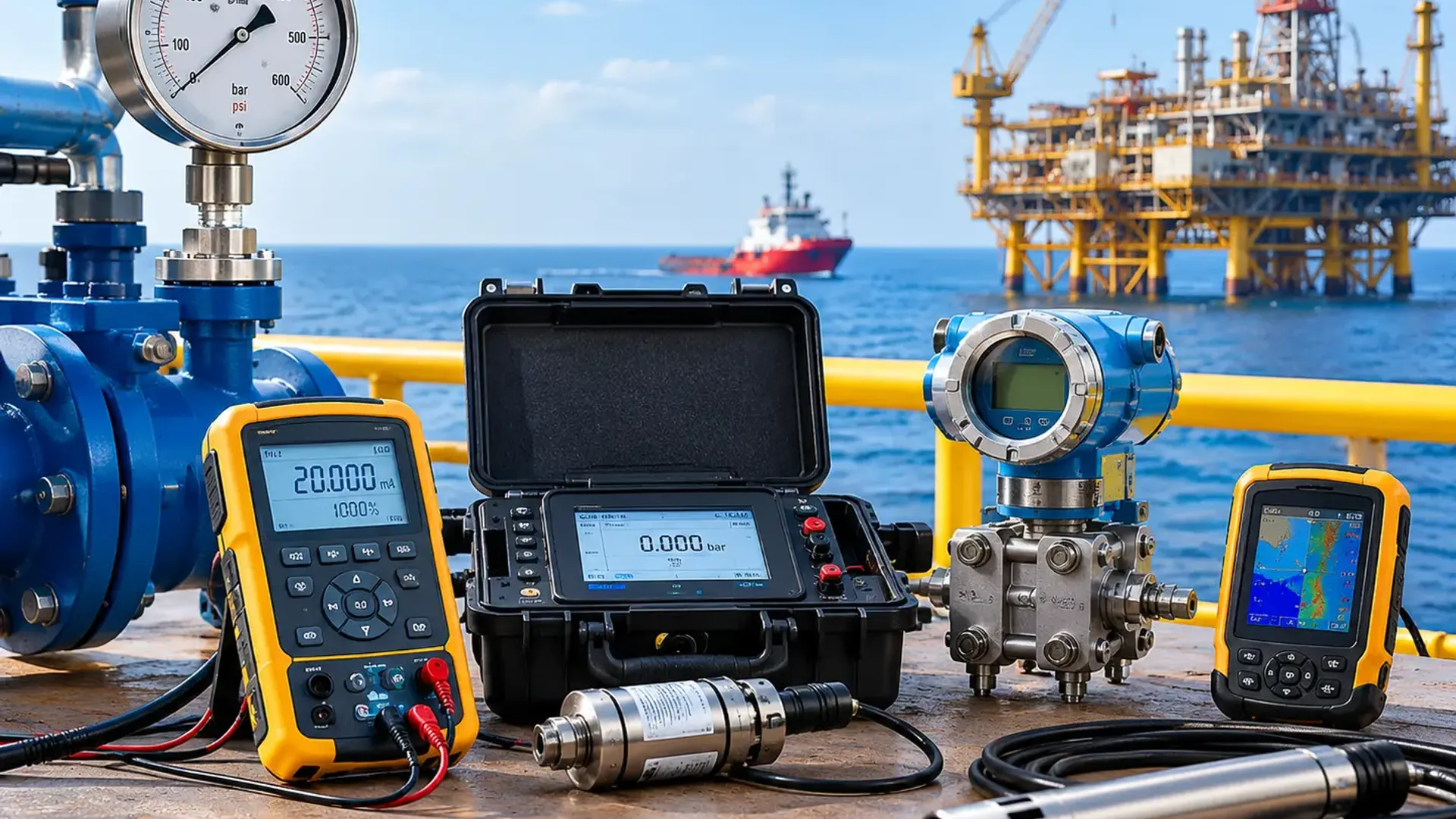
Marine and offshore work is hard on instruments and unforgiving of mistakes. Salt air attacks metal and electronics, vibration loosens everything, humidity creeps into housings, and equipment is often used in hazardous areas where a failure is not just an inconvenience. At the same time, the work depends on measurements: hull plate thickness, bolt torque on flanges, lifting loads, gas concentrations in enclosed spaces, pressures during testing.
This is why calibration for the marine and offshore industry in the UAE needs more planning than calibration in a controlled indoor plant. Instruments are in harsh environments, often at remote locations, with limited windows for work. This guide explains which instruments carry the most risk in marine and offshore operations, what makes the environment different, and how to build a calibration routine that fits shipyards, ports, vessels and offshore installations.
Why the Marine Environment Accelerates Drift
Several conditions common to marine and offshore settings shorten how long an instrument stays accurate:
- Salt-laden air and corrosion, which attack housings, connectors, sensors and mechanical movements
- Constant vibration, from engines, pumps, thrusters and wave action, which wears movements and loosens fittings
- High humidity and temperature swings, which stress electronics and seals
- Rough handling, since portable instruments move between vessels, yards, boats and platforms
- Hazardous area use, where equipment is specified for explosive atmospheres and must be handled carefully
A pressure gauge on a vessel pump or a gas detector in a cargo area is working in conditions far harsher than the datasheet assumes.
The Instruments That Matter Most
Gas Detectors
Enclosed spaces such as tanks, void spaces, cofferdams and pump rooms can hold toxic gases, flammable vapors or oxygen-deficient air. Portable and fixed detectors protect people entering and working in them, so routine bump tests and scheduled full calibration are essential. See our guide to gas detector calibration.
NDT and Thickness Gauging
Hull and structural integrity depend on measuring plate thickness and finding cracks and corrosion. Ultrasonic thickness gauges and flaw detectors are used for surveys, repairs and inspection of offshore structures, and their accuracy decides whether steel is accepted, renewed or repaired. See our guide to NDT calibration.
Torque Tools
Flange bolting, mooring equipment, structural connections and machinery assembly all rely on specified torque. Wrenches used on critical joints should be calibrated, tracked and checked before use. See our guide to torque wrench calibration.
Load Cells and Force Measurement
Cranes, winches, davits, lifting gear proof testing and mooring tension monitoring all depend on force measurement. Load cells and force gauges used for lifting and testing need accurate calibration, because the consequences of an error are severe. See our guides to load cell calibration and force gauge calibration.
Pressure and Temperature Instruments
Hydraulic systems, boilers, pressure vessels, hydrotesting and engine monitoring all use pressure and temperature instruments. See our guides to pressure gauge calibration and temperature calibration.
Flow and Fuel Metering
Where fuel, lubricants or process fluids are transferred, flow meters affect both cost and fairness between parties. Accurate metering supports reconciliation and reduces disputes. See our guide to flow meter calibration.
Classification Societies and Survey Requirements
Vessels and offshore structures are surveyed by classification societies such as DNV, Lloyd's Register, ABS and Bureau Veritas, and by port, flag and client inspectors. Requirements vary by society, survey type and contract, but the common expectation is that measurements used in surveys, such as thickness gauging results, come from instruments that are calibrated and traceable, often with certificates available for review. Ask the survey party or client what documentation they require before work starts.
Planning Around Limited Access Windows
Marine and offshore operations rarely allow open-ended downtime. Vessels have port schedules, yards have docking dates, and offshore facilities have shutdown and turnaround windows. Good planning includes:
- Building calibration due dates into the project or maintenance schedule well before the window
- Calibrating portable instruments before they go offshore or onto a vessel, so certificates are in date for the whole deployment
- Carrying calibrated spares for critical instruments such as gas detectors
- Using on-site calibration for fixed equipment and for yards and facilities where removal is impractical
- Keeping certificates accessible digitally for inspectors and surveyors
Calibration Intervals in Harsh Conditions
Because the environment is more demanding, intervals may need to be shorter than standard guidance:
- Calibrate heavily used and frequently moved instruments more often than the manufacturer baseline
- Check gas detectors before every use with a bump test, in addition to scheduled calibration
- Calibrate safety-critical lifting and testing instruments before major jobs
- Calibrate after any drop, immersion, overload or exposure to heavy corrosion
- Review intervals using as-found history to catch instruments that drift faster than expected
Our guide to calibration frequency in the UAE explains how to set and adjust intervals.
Protecting Instruments Between Calibrations
Good handling extends the time an instrument stays accurate. Rinse and dry instruments that have been exposed to seawater, store them in protective cases away from direct sun and moisture, use desiccant in cases where practical, avoid leaving instruments in hot vehicles, and keep calibration labels visible and legible. These simple habits reduce drift and prevent damage that is only discovered at the next calibration.
What Clients and Inspectors Typically Check
For marine and offshore work, reviewers commonly look for:
- Valid calibration certificates for the instruments used on the job
- Evidence that the calibrating laboratory is accredited, with the accreditation number
- Calibration dates before the measurement date
- A register of instruments with status and due dates
- Records showing action taken when an instrument failed
Calibration Support for Marine and Offshore Teams
Our laboratory is accredited by EIAC (LB-CAL-004) and ENAS (NAL 240) to ISO/IEC 17025 across gas detection, NDT, torque, force, pressure, flow, temperature and other disciplines, with on-site service across the UAE. Explore the full range of calibration disciplines.
Frequently Asked Questions
Which marine instruments are most safety-critical? Gas detectors, lifting and mooring load measurement devices, torque tools on critical joints and pressure instruments on hydraulic and pressure systems carry the highest consequences if they are inaccurate.
Why does the marine environment shorten calibration intervals? Salt, vibration, humidity, rough handling and temperature swings accelerate drift and damage, so instruments often need more frequent calibration than in controlled indoor settings.
Do classification society surveys require calibrated instruments? Generally, measurements used in surveys, such as thickness gauging, are expected to come from calibrated, traceable instruments, but requirements vary by society and survey type.
How should calibration be planned around vessel or shutdown schedules? Build due dates into the schedule early, calibrate before deployment, carry calibrated spares for critical instruments and use on-site calibration where removal is impractical.
Can calibration be done at a port or yard? Yes. On-site calibration brings reference standards to the location, which suits fixed equipment and limited access windows.
Closing Thoughts
Calibration for the marine and offshore industry in the UAE has to account for the realities of salt, vibration, remote locations and tight schedules. Matching intervals to harsh conditions, planning calibration around access windows, protecting instruments between calibrations and using an accredited provider keeps safety and survey measurements defensible.
To discuss calibration for your marine or offshore operation, reach out through the General Tech Services contact page.