Flow measurement sits at the intersection of process control and financial accounting in a way few other measurements do. Get it wrong on the process side and a reaction runs off-spec. Get it wrong on the custody transfer side and money changes hands based on a number nobody can actually stand behind. Both outcomes trace back to the same root cause: a flow meter that has quietly drifted since its last calibration.
This is why flow meter calibration UAE industrial, utility, and energy operations rely on cannot be treated as a routine box-ticking exercise. This guide covers how liquid and gas flow calibration actually works, the differences between major meter technologies, and what custody transfer applications demand beyond standard process calibration.
Why Flow Meter Calibration Carries Extra Weight
Unlike a pressure gauge or temperature sensor, a flow meter's output frequently feeds directly into billing, allocation, and regulatory reporting, not just process control. A few factors make flow calibration particularly consequential:
- Wear on internal moving components, common in turbine and positive displacement meters, changes the relationship between flow rate and output signal over time
- Fluid properties such as viscosity, density, and temperature affect meter performance differently depending on the underlying measurement technology
- Installation effects, including upstream and downstream piping configuration, can introduce errors that calibration in isolation from the actual installation may not catch
- Even small percentage errors compound into significant volumes when applied across continuous, high-throughput flow over time
A flow meter reading consistently 1% high might seem negligible on a single reading, but across a year of continuous production or custody transfer volume, that 1% represents a substantial and disputable quantity.
Liquid Flow Meter Calibration
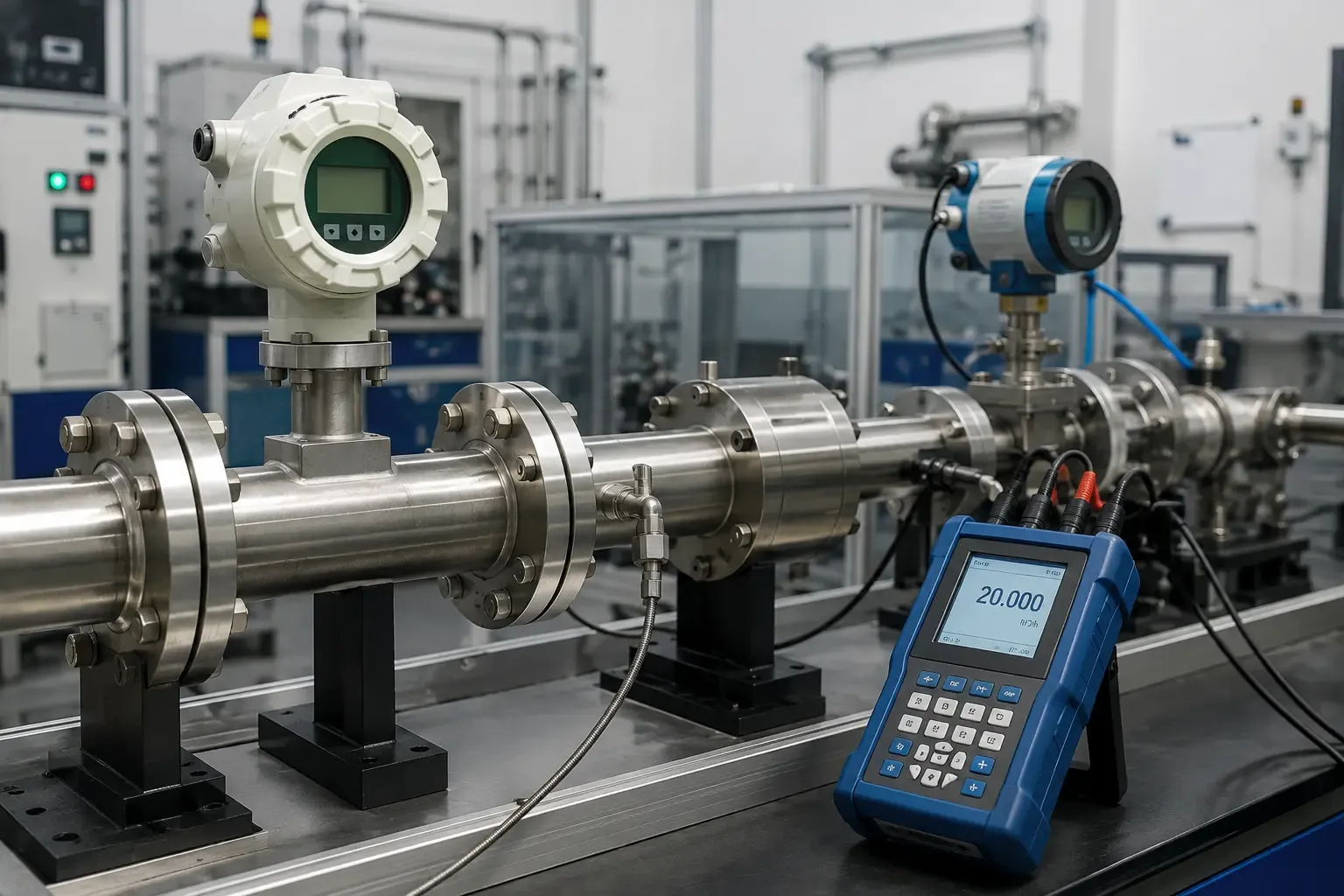
Liquid flow meter calibration verifies accuracy across meters measuring water, fuel, chemicals, and process liquids throughout industrial and utility applications. Calibration typically involves comparing the meter's output against a calibrated reference standard, commonly a gravimetric or volumetric proving system, across multiple flow rates spanning the meter's operating range. Key considerations for liquid flow calibration include:
- Verifying accuracy across low, mid, and high flow rates, since linearity is rarely uniform across a meter's full range
- Accounting for fluid viscosity and temperature, both of which can shift a meter's calibration curve
- Checking repeatability across multiple passes at the same flow rate to confirm consistent performance
Gas Flow Meter Calibration
Gas flow meter calibration presents distinct challenges compared to liquid calibration, primarily because gas is compressible and its volume changes significantly with pressure and temperature. Calibration for gas flow meters typically accounts for:
- Reference conditions, since gas flow is often reported at standard temperature and pressure rather than actual line conditions, requiring careful conversion during calibration
- Compressibility factors that affect the relationship between mass and volumetric flow
- Meter-specific behavior across the compressible flow regime, which differs meaningfully from how liquid meters respond
Gas flow calibration facilities typically use either a calibrated reference meter in series with the unit under test, or a primary standard such as a piston prover or bell prover, depending on the flow rates and accuracy requirements involved. Facilities running gas flow monitoring alongside hazard detection often calibrate both under the same program, since our gas analyser and detector calibration services cover the safety-monitoring side of gas handling that frequently sits alongside flow metering points.
Turbine Flow Meter Calibration
Turbine flow meter calibration addresses one of the most widely used flow measurement technologies, relying on a rotor that spins in proportion to fluid velocity. Calibration for turbine meters focuses heavily on:
- Bearing wear, since even minor bearing friction changes can shift the meter's calibration factor
- Verification across the meter's full linear range, since turbine meters typically have a defined operating range outside of which accuracy degrades
- K-factor verification, the calibration constant relating rotor pulses to volume, which needs periodic reconfirmation as the meter ages
Because turbine meters have moving parts subject to mechanical wear, they generally require more frequent recalibration than non-mechanical alternatives like ultrasonic meters.
Ultrasonic Flow Meter Testing
Ultrasonic flow meter testing covers a meter technology that uses sound wave transit time or Doppler shift to measure flow without any moving parts in contact with the fluid. This gives ultrasonic meters certain calibration advantages, including reduced wear-related drift, but calibration still needs to verify:
- Transducer alignment and signal strength, since physical or fouling-related changes can affect measurement accuracy
- Accuracy across the meter's full flow range and both flow directions where bidirectional measurement applies
- Performance consistency against changing fluid conditions, particularly relevant for meters used across varying process fluids
Ultrasonic meters are increasingly common in custody transfer applications specifically because their lack of moving parts translates into more stable long-term performance between calibrations, though periodic verification remains essential.
Coriolis Flow Meter Calibration
Coriolis flow meter calibration applies to meters that measure mass flow directly by detecting the Coriolis effect as fluid moves through vibrating tubes. Because Coriolis meters measure mass rather than volume, they offer inherent advantages for applications where fluid density varies, and calibration for these meters verifies both mass flow accuracy and density measurement accuracy, since many Coriolis meters report both simultaneously. This dual verification requirement makes Coriolis calibration more involved than single-parameter flow meter types.
Custody Transfer Flow Calibration: A Higher Standard
Custody transfer flow calibration applies wherever flow measurement determines a financial transaction between parties, such as fuel loading, pipeline transfer points, or gas metering stations. This category of calibration demands stricter requirements than general process flow measurement:
- Tighter accuracy tolerances, since even small percentage errors translate directly into financial discrepancies at scale
- More frequent calibration intervals, often driven by contractual or regulatory requirements rather than general maintenance schedules
- Comprehensive documentation supporting the calibration, since custody transfer certificates may be scrutinized in commercial disputes
- Verification against nationally or internationally traceable reference standards, given the financial weight placed on the results
For custody transfer metering UAE operations involved in fuel distribution, pipeline transport, or gas allocation, working with a calibration provider experienced specifically in this higher-stakes category of flow measurement is essential, since the documentation standard expected in a commercial dispute differs meaningfully from routine process calibration. Metering points at remote or offshore locations often benefit from on-site calibration services that bring reference standards directly to the facility rather than pulling custody transfer meters out of service for lab testing.
ISO 17025 Flow Calibration and EIAC Accredited Flow Calibration
ISO 17025 flow calibration ensures the laboratory performing the work has been independently assessed for technical competence, with reference standards traceable to national or international standards and a documented measurement uncertainty attached to every result. EIAC accredited flow calibration specifically confirms this competence has been verified by the UAE's national accreditation body, giving the resulting certificate recognized standing for both regulatory compliance and commercial purposes.
Our flow meter calibration services cover liquid, gas, and air flow across a wide range of meter types, performed under full EIAC ISO 17025 accreditation.
What a Flow Meter Calibration Certificate Should Include
A properly issued flow meter calibration certificate should clearly document:
- The specific meter make, model, and serial number
- Measurement results at each tested flow rate compared against the reference standard
- Stated tolerance and pass or fail status at each point
- The measurement uncertainty for the calibration
- Reference conditions used, particularly important for gas flow calibration
- The accreditation body and standard the issuing laboratory operates under
For custody transfer applications, certificates should also reference the specific traceability chain supporting the reference standards used, given the financial weight these documents may carry. Facilities calibrating flow meters typically run parallel programs for related equipment, including mass calibration for weighing systems tied to volumetric reconciliation, and dimensional calibration for tank gauging and measurement equipment used in flow verification setups.
How Often Should Flow Meters Be Calibrated
General guidance for flow meter calibration frequency includes:
- Annual calibration as a standard baseline for general process flow monitoring
- More frequent intervals, often quarterly or biannual, for custody transfer or fiscal metering applications, typically dictated by contractual or regulatory requirements
- Immediate recalibration after any suspected mechanical damage, unusual reading pattern, or process upset affecting the metering point
- Extended intervals may be justified for non-mechanical meter types like ultrasonic or Coriolis meters with a strong stability track record, supported by historical calibration data
Frequently Asked Questions
How is gas flow meter calibration different from liquid flow calibration? Gas is compressible, so calibration must account for pressure and temperature effects on volume, along with converting results to standard reference conditions, while liquid flow calibration deals primarily with viscosity and temperature effects on an essentially incompressible fluid.
Why do custody transfer flow meters need more frequent calibration than general process meters? Custody transfer measurements directly determine financial transactions, so tighter accuracy tolerances and more frequent verification are typically required by contract or regulation to minimize the financial impact of any measurement drift.
Which flow meter technology requires the least frequent calibration? Non-mechanical technologies like ultrasonic and Coriolis meters generally experience less wear-related drift than mechanical meters like turbine meters, which can support longer intervals between calibrations, though this should be confirmed through historical performance data rather than assumed.
What is a K-factor in turbine flow meter calibration? The K-factor is the calibration constant relating the meter's rotor pulse output to actual fluid volume. It can shift as bearing wear or other mechanical changes occur, which is why periodic reconfirmation through calibration is necessary.
Can a flow meter be calibrated without removing it from the pipeline? In some cases, portable reference meters can be used for on-site verification without full removal, though for the highest accuracy requirements, particularly custody transfer applications, calibration against a laboratory-based primary standard is generally preferred.
Closing Thoughts
Flow meter calibration UAE industrial, utility, and energy operations depend on protects both process integrity and financial accuracy simultaneously, which is a rare combination among measurement disciplines. Whether verifying a turbine meter on a general process line or a Coriolis meter feeding a custody transfer calculation, calibration performed against traceable reference standards is what keeps both sides of that equation defensible.
To schedule flow meter or broader industrial calibration across the UAE, connect with the team through the contact page, browse the complete list of ISO 17025 accredited calibration disciplines covering flow, pressure, temperature, and dimensional measurement, or see the full range of services General Tech Services provides across calibration, automation, and engineering solutions.