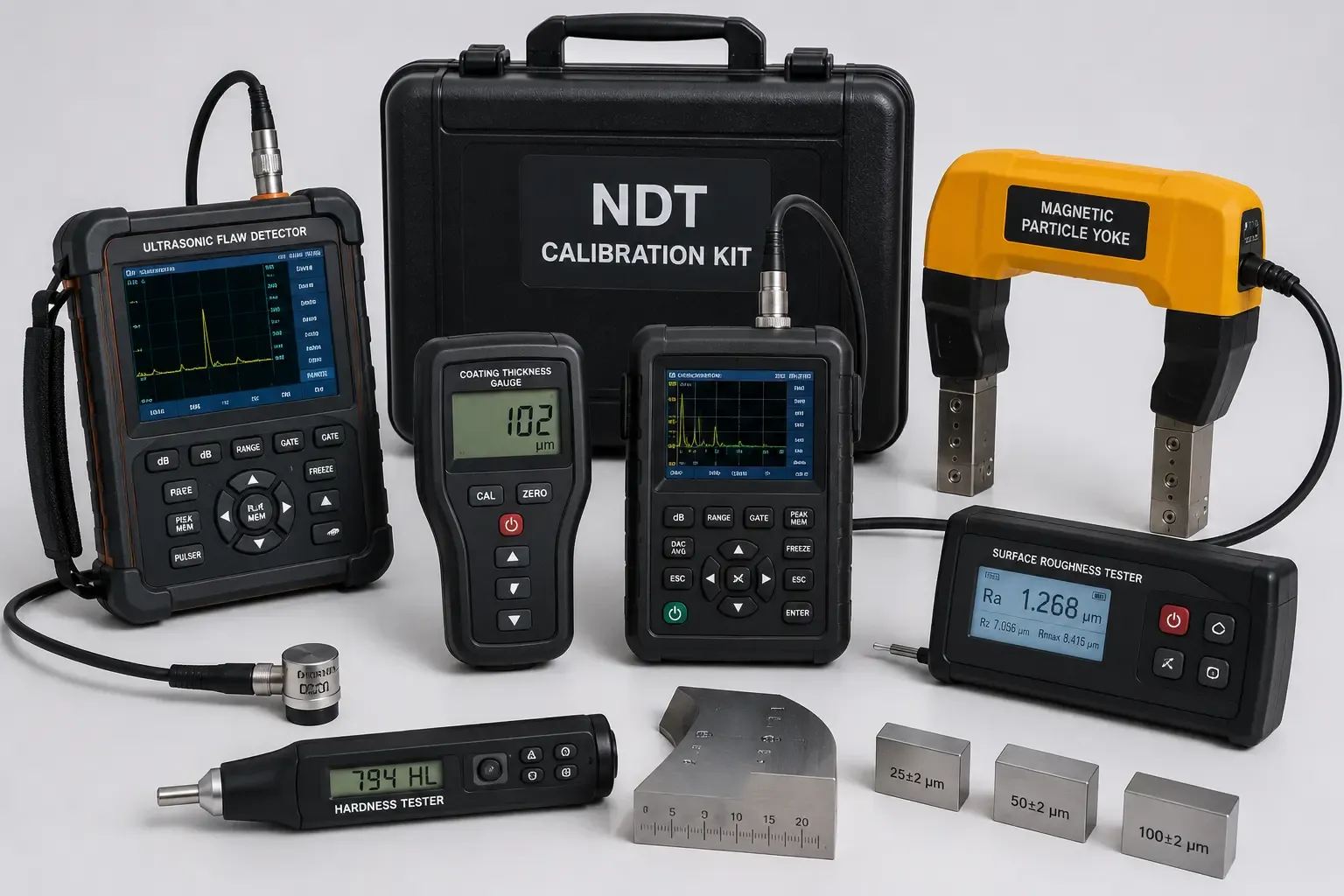
Non-destructive testing keeps UAE industry safe. Oil and gas operators, contractors, and manufacturers all depend on NDT instruments to catch flaws before they become failures. But an NDT instrument is only as reliable as its last calibration. If your ultrasonic flaw detector or MPI equipment is drifting out of tolerance, you could be missing real defects without knowing it.
That's where NDT calibration services UAE come in. Regular calibration keeps non-destructive testing instruments UAE accurate, traceable, and compliant with the standards regulators expect. This guide breaks down what NDT calibration actually involves, which instruments need it, and how to choose a lab that gets it right.
What Is NDT Calibration
NDT calibration is the process of checking an NDT instrument against a known reference standard and adjusting it so its readings stay accurate. This applies to ultrasonic flaw detector calibration UAE, eddy current testing, magnetic particle inspection, and radiography testing equipment calibration, among others.
Any organization running material testing, weld verification, or structural inspection programs needs this on a routine schedule. Skipping it isn't a paperwork risk, it's a safety risk. A miscalibrated instrument can pass a defective weld or a corroded pipeline wall as sound.
Why NDT Equipment Calibration Dubai and UAE-Wide Matters
Uncalibrated equipment produces false confidence. It can miss subsurface cracks, corrosion, or delamination that a properly calibrated instrument would catch. In regulated sectors like oil and gas, petrochemical, and aerospace, this isn't optional. ASME and API frameworks require documented, traceable calibration as part of standard compliance.
There's also a cost angle. Catching a flaw early through accurate NDT is far cheaper than dealing with a failure in the field. Calibration is the small recurring cost that protects against the much larger one.
Instruments That Need Calibration
A wide range of non-destructive testing instruments UAE facilities rely on require periodic calibration, including:
- Ultrasonic flaw detectors — used to find subsurface defects in welds, forgings, and castings
- Ultrasonic thickness meters — used for corrosion monitoring and wall thickness verification
- Eddy current flaw detectors — used to detect surface and near-surface cracks in metallic components
- MPI (magnetic particle inspection) equipment — used on ferromagnetic materials in heavy industry
- Bond testers — used in aerospace and composite inspection
- UV meters, light meters, and gauss meters — used to support fluorescent penetrant and magnetic particle testing
- Conductivity meters and reference blocks — used for material sorting and heat treatment verification
If your team runs any of these, they belong on a calibration schedule, not a "calibrate when something looks off" basis.
Ultrasonic Flaw Detector Calibration UAE: What's Involved
Ultrasonic flaw detector calibration checks instrument sensitivity, linearity, and time-base accuracy against reference standards. This matters because these instruments are often the first line of defense on welds, forgings, and pressure-retaining components. A provider offering accredited ultrasonic flaw detector calibration UAE, such as General Tech Services' NDT calibration services, tests across all major instrument brands and models, not just one manufacturer's line.
Radiography Testing Equipment Calibration
Radiography testing equipment calibration ensures density, exposure, and imaging accuracy stay within tolerance, which is essential for weld radiography and casting inspection work governed by ASME and API codes. Alongside radiography, related optical and light-measurement instruments, like UV meters and light meters used in fluorescent penetrant testing, also need their own calibration checks to remain compliant.
How Often Should NDT Instruments Be Calibrated
Most NDT instruments need calibration every 6 to 12 months, though the exact interval depends on instrument type, usage intensity, and the standard you're working to. Your calibration certificate should always state the next recommended due date, and a good provider will send automated reminders so nothing lapses unnoticed. For a broader look at what falls under a full-service lab's scope, see What Instruments Does General Tech Services Calibrate in UAE?
Choosing an NDT Calibration Company Abu Dhabi and UAE-Wide
When evaluating an NDT calibration company Abu Dhabi businesses can rely on, look for a few non-negotiables:
- ISO 17025 NDT calibration UAE accreditation, ideally backed by EIAC and ENAS recognition
- Documented as-found and as-left results with measurement uncertainty reporting
- Compliance with ASME and API standards, not just generic in-house procedures
- Coverage across all major instrument brands, so you're not stuck using multiple labs
- On-site calibration options for facilities that can't afford equipment downtime
General Tech Services, an EIAC and ENAS accredited ISO 17025 calibration laboratory operating since 1998, provides NDT calibration services UAE covering ultrasonic, eddy current, MPI, bond testing, and optical measurement instruments across Dubai, Abu Dhabi, Sharjah, and all seven Emirates. Their calibration lab performs over 33,000 calibrations a year through a team of 50+ certified technicians. This same accredited approach carries over to related disciplines, such as their volumetric calibration services.
Frequently Asked Questions
What is NDT calibration? NDT calibration is the process of comparing an NDT instrument's readings against a known, traceable reference standard and adjusting it to ensure accurate results without damaging the tested material.
Which instruments require NDT calibration? Ultrasonic flaw detectors, ultrasonic thickness meters, eddy current flaw detectors, bond testers, MPI equipment, UV and light meters, gauss meters, and conductivity meters all require regular calibration.
How often should NDT equipment be calibrated? Typically every 6 to 12 months, depending on instrument type, usage, and the applicable standard.
Is on-site NDT calibration available in the UAE? Yes. Accredited providers like General Tech Services offer on-site NDT calibration across Dubai, Abu Dhabi, Sharjah, and the rest of the UAE, in addition to in-lab service.
What standards govern NDT calibration in the UAE? ISO 17025, ISO 9001, ASME, and API standards, along with manufacturer specifications and customer-specific procedures where applicable.
Closing Thought
NDT instruments only protect your operation if they're telling the truth. Building a routine NDT calibration schedule, backed by an ISO 17025 accredited lab, is what keeps your inspection data trustworthy and your compliance record clean. If it's been more than a year since your ultrasonic, eddy current, or MPI equipment was checked, that's the first thing worth fixing.