A pipette dispensing 1% less liquid than it displays sounds like a trivial error, right up until that small deviation compounds across a titration, a dilution series, or a pharmaceutical formulation, and suddenly a lab's entire dataset is quietly skewed in one direction. Volumetric glassware and instruments are trusted to deliver exact quantities precisely because so much downstream analytical work assumes they're correct without question.
This is why volumetric calibration UAE laboratories, pharmaceutical manufacturers, and food testing facilities depend on needs to follow a rigorous, documented method rather than an assumption that a pipette straight out of the box is automatically accurate. This guide covers how volumetric calibration actually works, which instruments it covers, and why the gravimetric method remains the gold standard for verifying liquid volume.
Why Volumetric Instruments Need Calibration at All
It's tempting to assume a pipette or burette, being a relatively simple mechanical or glass device, doesn't really need the same calibration rigor as an electronic instrument. In practice, several factors make volumetric accuracy genuinely fragile:
- Mechanical pipettes have internal seals, springs, and pistons that wear with repeated use, gradually shifting delivered volume
- Glassware calibration marks assume a specific reference temperature, commonly 20°C, and both the liquid and the glass itself expand or contract with temperature changes
- Improper technique, such as inconsistent meniscus reading or incorrect tip angle, can introduce errors that mimic instrument drift even when the device itself is fine
- Contamination, residue, or chipped glassware edges can meaningfully affect the volume actually delivered
Precise volume measurements are critical in industries like pharmaceuticals, laboratories, food and beverage, environmental testing, and chemical processing, which is exactly why volumetric instruments cannot be assumed accurate simply because they look undamaged and function normally.
What Volumetric Calibration Actually Covers
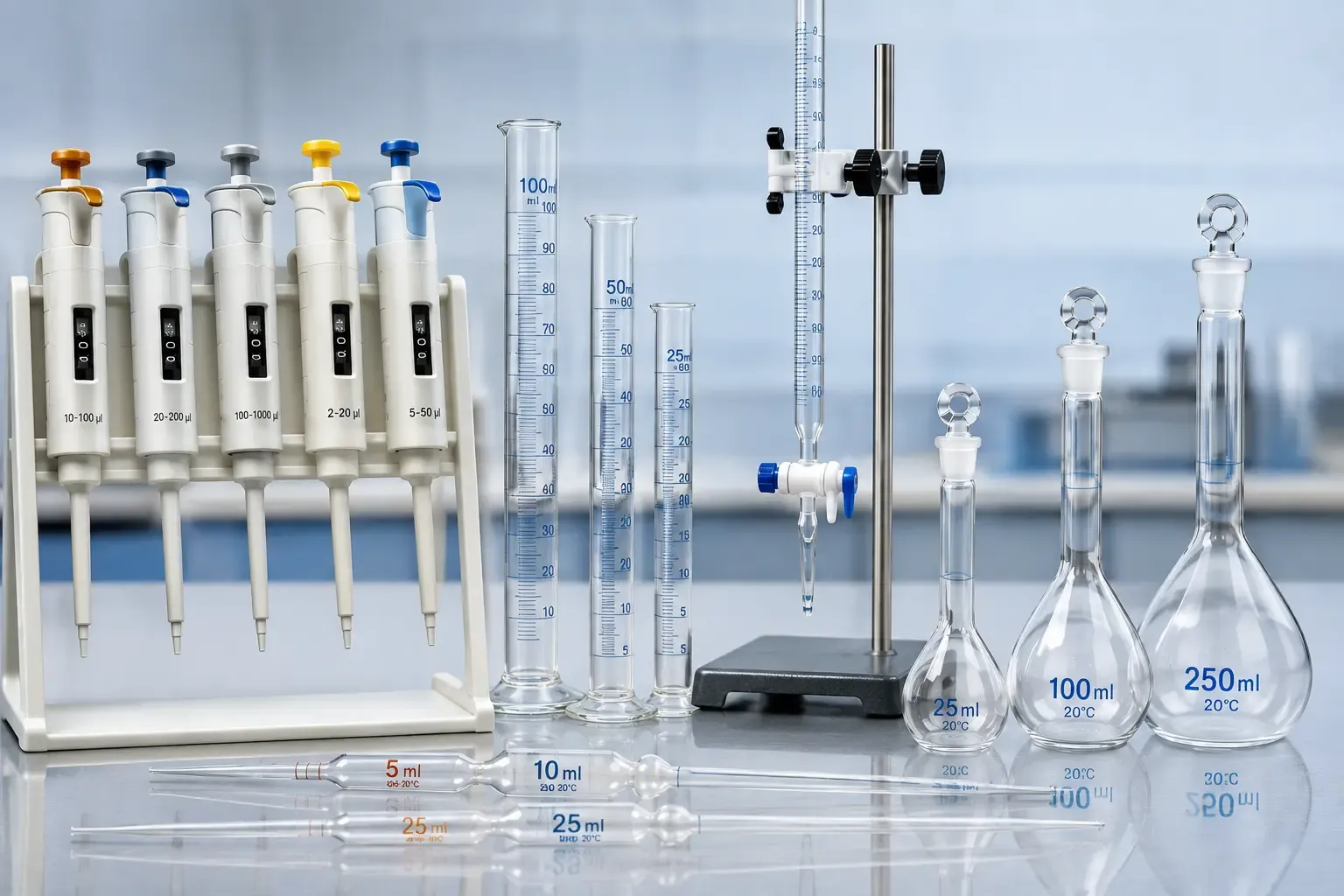
Volumetric calibration spans a range of instruments beyond just pipettes, including beakers, burettes, volumetric flasks, flow cups, and flow measuring devices such as rotameters, wet gas flow meters, and water meters. Each of these instrument types carries a different accuracy expectation:
- Volumetric flasks and volumetric pipettes are manufactured to relatively tight tolerances, since they're specifically designed for precise quantitative work
- Beakers and Erlenmeyer flasks carry much looser manufacturer-stated accuracy, typically around 5%, since they're intended for general laboratory use rather than precision measurement
- Burettes, used extensively in titration work, require careful calibration across their full graduated scale, not just at a single volume point
Understanding which category a given piece of glassware or equipment falls into matters, since applying pipette-level accuracy expectations to a general-purpose beaker sets an unrealistic standard that the instrument was never designed to meet.
The Gravimetric Method: How Volumetric Calibration Actually Works
The standard technique used to calibrate volumetric instruments is the gravimetric method, which determines volume indirectly by measuring the mass of water delivered or contained, then converting that mass to volume using water's known density at the measured temperature. The general process follows this sequence:
- A clean, dry container is weighed empty on a calibrated analytical balance to establish a tare weight
- Distilled or deionized water, ideally de-gassed to avoid density inaccuracies from dissolved air, is drawn into or delivered by the instrument being calibrated
- The container holding the delivered water is weighed again, and the difference between the two weights gives the mass of water delivered
- That mass is converted to volume using the known density of water at the measured temperature, since water's density varies meaningfully with temperature
- The calculated volume is compared against the instrument's stated or nominal volume, with deviation recorded
- The process is typically repeated multiple times at each tested volume point to confirm consistency and calculate repeatability
This method works because water's density at a given temperature is a well-established physical constant, giving the calibration a fundamentally traceable basis rather than relying on comparison against another uncalibrated reference.
Pipette Calibration in Detail
Pipette calibration typically tests accuracy at multiple points across the instrument's range rather than a single volume, since a pipette can perform accurately at one setting while deviating meaningfully at another. For a graduated pipette, this commonly means testing at several intervals across its scale, such as checking a 10ml pipette at 2ml, 4ml, 6ml, 8ml, and 10ml points, capturing performance across the full range rather than just the maximum capacity.
Before testing begins, the pipette and its filler or pipetting mechanism should be inspected for damage, chips, or contamination, since physical defects can introduce errors that have nothing to do with the underlying calibration accuracy being tested.
Burette Calibration
Burettes present a distinct calibration challenge because they're typically used to deliver variable volumes rather than a single fixed amount, most commonly in titration work where the exact volume dispensed is the actual measurement being taken. Calibration for burettes verifies accuracy across the graduated scale, checking that the volume delivered between any two points on the scale matches what the markings indicate, since burette users frequently rely on the difference between two readings rather than an absolute volume from empty.
Volumetric Flasks and Beakers
Volumetric flasks are calibrated by weighing the empty flask, then weighing it again filled precisely to the calibration mark with water, converting that mass difference to volume using the same gravimetric principle applied to pipettes and burettes. Because volumetric flasks are designed to contain a specific volume rather than deliver it, their calibration mark represents the "to contain" volume, a distinction worth understanding since it differs from how delivery-type instruments like pipettes are calibrated and marked.
Flow Measuring Devices Within Volumetric Calibration
Beyond glassware, volumetric calibration also extends to flow cups and flow measuring devices such as rotameters, wet gas flow meters, and water meters, instruments that measure volume flow rather than a static contained or delivered quantity. These devices require calibration against known reference volumes over measured time intervals, verifying that displayed flow rates correspond accurately to actual volumetric throughput.
Calibration Frequency: At Receipt and Beyond
A properly run volumetric calibration program establishes accuracy at the time of receipt, before an instrument enters regular service, giving a documented baseline before any wear or handling has occurred. Beyond that initial calibration, ongoing intervals depend on usage intensity and application criticality:
- Annual calibration as a general baseline for instruments used in routine laboratory work
- More frequent calibration for pipettes and burettes used heavily in high-throughput quality control or pharmaceutical production environments
- Immediate recalibration after any suspected damage, dropped glassware, or unusual measurement inconsistency
- Verification checks between full calibrations for instruments used in particularly critical formulation or analytical work
ISO 17025 Accredited Volumetric Calibration
Our volumetric calibration services cover pipettes, beakers, burettes, flow cups, and flow measuring devices under full EIAC ISO 17025 accreditation, supporting laboratories, pharmaceutical manufacturers, food and beverage facilities, environmental testing labs, and chemical processing operations across the UAE.
What a Volumetric Calibration Certificate Should Include
A properly issued calibration certificate should clearly document:
- The specific instrument type, nominal volume, and identifying details
- Measured results at each tested volume point
- The reference temperature used for the calibration, since volumetric accuracy is temperature-dependent
- Stated tolerance and pass or fail status at each point
- The measurement uncertainty associated with the calibration
- The accreditation body and standard the issuing laboratory operates under
Frequently Asked Questions
Why is the gravimetric method used for volumetric calibration instead of a direct volume comparison? Water's density at a given temperature is a well-established physical constant, giving mass-based calibration a fundamentally traceable basis. Measuring mass on a precision balance is also generally more accurate and repeatable than attempting to compare volumes directly against another reference vessel.
Why does temperature matter so much in volumetric calibration? Both water and the glassware or instrument itself expand and contract with temperature changes, meaning a volume that's accurate at one temperature won't necessarily be accurate at another. This is why calibration is performed and referenced at a standard temperature, commonly 20°C.
Does a new pipette straight from the manufacturer need calibration? Yes. Establishing calibration at the time of receipt creates a documented baseline before the instrument enters service, confirming its actual performance rather than assuming the manufacturer's stated specification holds true for that specific unit.
How is burette calibration different from pipette calibration? Burettes are typically used to measure the difference between two readings during titration rather than a single delivered volume, so calibration focuses on verifying accuracy across the graduated scale rather than at one fixed capacity point.
What causes a pipette to lose accuracy over time? Mechanical wear in internal seals, springs, and pistons gradually shifts delivered volume, while contamination, residue buildup, or physical damage to the tip can also introduce errors that accumulate with regular use.
Closing Thoughts
Volumetric calibration UAE laboratories and manufacturing facilities depend on protects the accuracy underlying every titration, dilution, and formulation built on trusted glassware and instruments. Whether calibrating a single precision pipette or a full fleet of burettes and flasks across a pharmaceutical quality control lab, the gravimetric method, performed under proper temperature control and documented traceability, is what keeps that foundational accuracy defensible.
To schedule volumetric or broader laboratory instrument calibration across the UAE, reach out through the General Tech Services contact page, or explore the full range of ISO 17025 accredited calibration disciplines covering volumetric, dimensional, electrical, and temperature measurement.