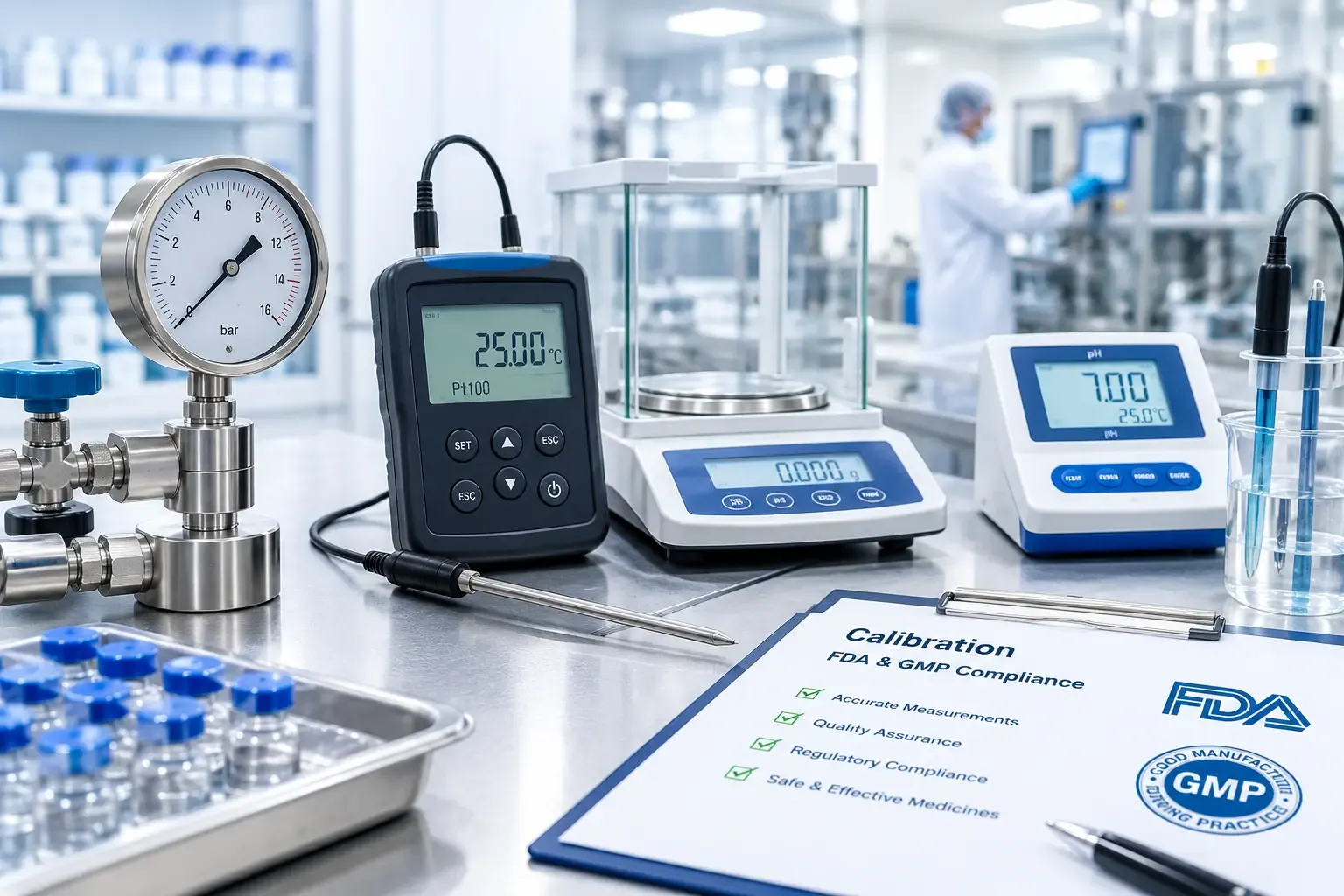
In pharmaceutical manufacturing, a measurement is never just a number. It is evidence. The weight of an active ingredient, the temperature of a sterilization cycle, the humidity of a storage room, the pressure difference between a cleanroom and its corridor: each one is recorded, reviewed and eventually shown to an inspector as proof that a medicine was made and stored correctly. If the instrument behind that number cannot be trusted, neither can the record.
This is why calibration for the pharmaceutical industry in UAE is treated as a regulatory requirement rather than a maintenance task. This guide covers what GMP and FDA rules expect, which instruments carry the most risk, how calibration fits into equipment qualification, and what an audit-ready calibration program looks like.
What GMP and FDA Rules Expect
Good Manufacturing Practice frameworks differ in detail, but they agree on the principle that measuring and control equipment must be calibrated against traceable standards under a defined program.
The US FDA's current good manufacturing practice regulations for finished pharmaceuticals (21 CFR Part 211) require that instruments, apparatus, gauges and recording devices be calibrated at suitable intervals under an established written program. That program must specify directions, schedules, accuracy and precision limits, and remedial action if those limits are not met. Equipment that does not meet specification must not be used. Related provisions require automatic, mechanical and electronic equipment to be routinely calibrated, inspected or checked according to a written program.
EU GMP, WHO GMP and PIC/S guidance contain equivalent expectations: weighing, measuring, recording and control equipment calibrated and checked at defined intervals using appropriate methods, with records kept.
Which framework applies to a UAE manufacturer depends on the markets it supplies and the approvals it holds, along with the requirements of local health authorities. Many UAE manufacturers and distributors work to more than one, so a calibration program built to the stricter expectations usually satisfies all of them. Confirm the specific requirements that apply to your licenses and export markets.
Calibration Within Qualification and Validation
Calibration does not stand alone in pharmaceutical operations. It supports equipment qualification, the structured process of proving equipment is suitable for its purpose:
- Installation qualification confirms the equipment is installed correctly and its instruments are identified
- Operational qualification confirms it operates within defined limits, which depends on calibrated instruments
- Performance qualification confirms it performs consistently in real use
Critical instruments are typically calibrated before operational qualification starts, so the qualification data itself rests on trustworthy measurements. The same applies to process validation and to temperature mapping studies of warehouses, cold rooms and chambers.
The Instruments That Carry the Most Risk
Most pharmaceutical facilities share the same critical measurement categories.
Weighing
Balances and scales control dosing accuracy, batching and formulation. Analytical and precision balances should be calibrated with weights of an appropriate class and checked routinely between formal calibrations. See our guide to mass calibration.
Temperature and Humidity
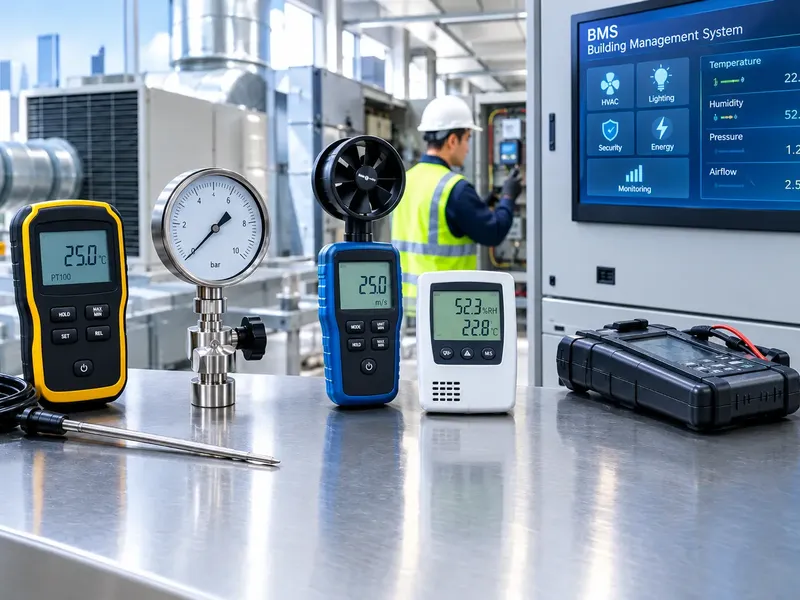
Sterilizers, ovens, incubators, stability chambers, refrigerators and warehouses depend on accurate temperature and humidity control. Excursions can affect potency and shelf life. For the details, see our guides to temperature calibration, temperature data logger calibration and humidity calibration.
Pressure and Differential Pressure
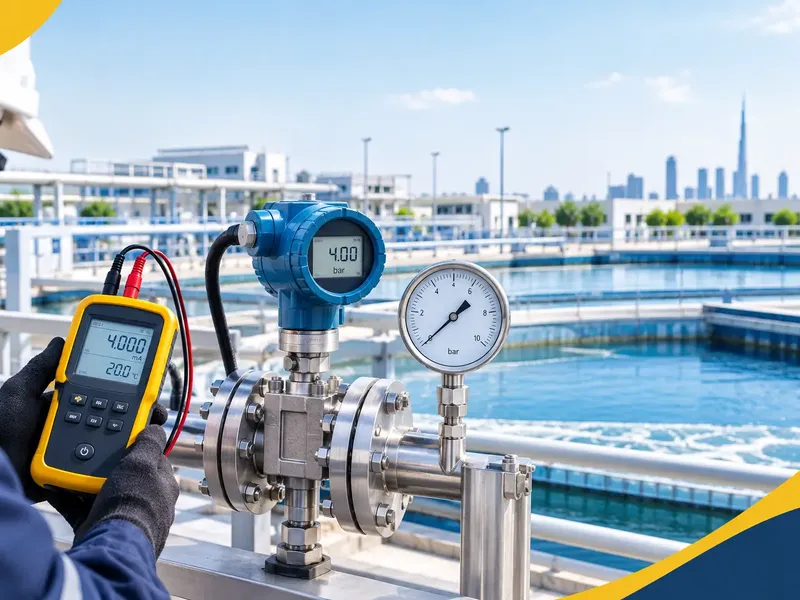
Autoclaves, filtration systems and compressed gas lines rely on pressure instruments, while cleanrooms depend on small differential pressure readings to keep air flowing in the right direction. Our guides to pressure gauge calibration and manometer calibration cover these.
pH and Laboratory Instruments
Quality control laboratories rely on pH meters, pipettes, burettes and volumetric glassware for analytical results that release or reject batches. See our guides to pH meter calibration and volumetric calibration.
Other Production Instruments
Flow meters on purified water and process lines, electrical test equipment used by engineering teams, and dimensional tools used on packaging and tablet tooling also belong on the register.
Setting Up a Risk-Based Calibration Program
A defensible program starts by classifying instruments by their impact on product quality and patient safety:
- Critical instruments directly affect product quality or safety, such as sterilizer sensors, balances used for dosing, and storage temperature loggers. They get the tightest tolerances and shortest intervals
- Non-critical instruments support operations but do not directly affect product quality. They can follow longer intervals with lighter controls
- Reference-only instruments provide information only and may not need calibration, but that decision must be documented
For each critical instrument, define the range used, the tolerance required by the process rather than the manufacturer's nominal accuracy, the calibration interval, and the action if it is out of tolerance. Our guide to calibration frequency in the UAE explains how to set and review intervals.
As-Found Data and Out-of-Tolerance Events
In a regulated environment, an out-of-tolerance result is a quality event. The usual response is to remove the instrument from use, assess whether any product, process step or record was affected since its last good calibration, raise a deviation, apply corrective and preventive action, and document the conclusion.
Doing this properly requires as-found data, meaning the instrument's condition before adjustment. A certificate that records only as-left results leaves you unable to assess impact. Choose a calibration provider whose certificates report as-found and as-left results, the uncertainty, and the reference standards used.
Records and Data Integrity
Calibration records are GMP records and should meet the same data integrity expectations as other quality records: attributable, legible, contemporaneous, original and accurate. In practice:
- Keep a controlled instrument register with unique identifiers
- Keep original certificates, not just summaries, readily retrievable
- Label instruments with calibration status and due dates
- Retain records for the period your quality system requires
- Control changes to intervals and tolerances through documented review
Choosing a Calibration Provider for a GMP Environment
Pharmaceutical auditors will look closely at the provider behind your certificates. Look for:
- Accreditation to ISO/IEC 17025 that covers the relevant disciplines and ranges
- Calibration points and tolerances that match your process, not just a generic procedure
- As-found and as-left data, measurement uncertainty and traceability on every certificate
- Reliable turnaround so instruments are not out of service for long
- On-site capability for fixed equipment such as chambers, sterilizers and cold rooms
Our laboratory is accredited by EIAC (LB-CAL-004) and ENAS (NAL 240) across 15 disciplines, which lets a plant cover mass, temperature, humidity, pressure, pH, volumetric and other instruments through one provider. See our full range of calibration disciplines and our on-site calibration option.
Frequently Asked Questions
Does GMP require calibration? Yes. GMP frameworks, including FDA 21 CFR Part 211, require instruments to be calibrated at suitable intervals under a written program, with traceability and action when limits are not met.
What is the difference between calibration and qualification? Calibration verifies an instrument's accuracy, while qualification proves equipment is installed, operates and performs as intended. Qualification relies on calibrated instruments.
Why is as-found data important in pharma? It shows the instrument's condition before adjustment, which is needed to assess whether past batches, cycles or records were affected by an out-of-tolerance result.
How often should pharmaceutical instruments be calibrated? Intervals are set by risk. Critical instruments are often calibrated at least annually and sometimes more often, with intervals reviewed using as-found history.
Do pharmaceutical companies need an ISO 17025 accredited calibration provider? Not always by name, but accredited, traceable calibration is the standard evidence auditors expect for critical instruments, and it simplifies inspections.
Closing Thoughts
Calibration for the pharmaceutical industry in UAE is how a manufacturer proves its measurements deserve trust. Classifying instruments by risk, calibrating at points that match the process, keeping as-found data, and working with an accredited provider turns calibration from an annual chore into a core part of a credible quality system.
To discuss calibration for your pharmaceutical facility, reach out through the General Tech Services contact page.