Humidity rarely gets the attention temperature and pressure do, right up until a pharmaceutical storage room, a museum archive, or a food processing line has a moisture-related failure that traces straight back to a hygrometer nobody thought to calibrate. Relative humidity readings quietly govern shelf life, product stability, and material integrity across far more industries than most people realize.
This is exactly why humidity calibration services UAE pharmaceutical, food, and manufacturing facilities depend on need the same rigor applied to temperature and pressure instruments. This guide covers what humidity calibration actually involves, which instruments it spans, and why environmental mapping matters as much as the calibration itself.
Why Humidity Measurement Is Trickier Than It Looks
Unlike temperature or pressure, which are measured through relatively direct physical principles, humidity measurement typically relies on inferring moisture content from another underlying metric, such as electrical capacitance, resistance, or a wet and dry bulb temperature differential. This indirect measurement approach introduces specific accuracy challenges:
- Sensor drift accelerates in environments with contaminants, dust, or chemical exposure, common in industrial and food processing settings
- Response time varies significantly between sensor technologies, meaning some hygrometers lag behind rapid humidity changes more than others
- Calibration reference points themselves require careful preparation, since generating a precisely known humidity level is inherently more complex than generating a known pressure or temperature
- Environmental factors during calibration, including ambient temperature, can meaningfully skew results if not properly controlled
Because of this complexity, humidity calibration demands specialized reference equipment and technique that general electrical or temperature calibration experience doesn't automatically provide.
What Falls Under Humidity Calibration
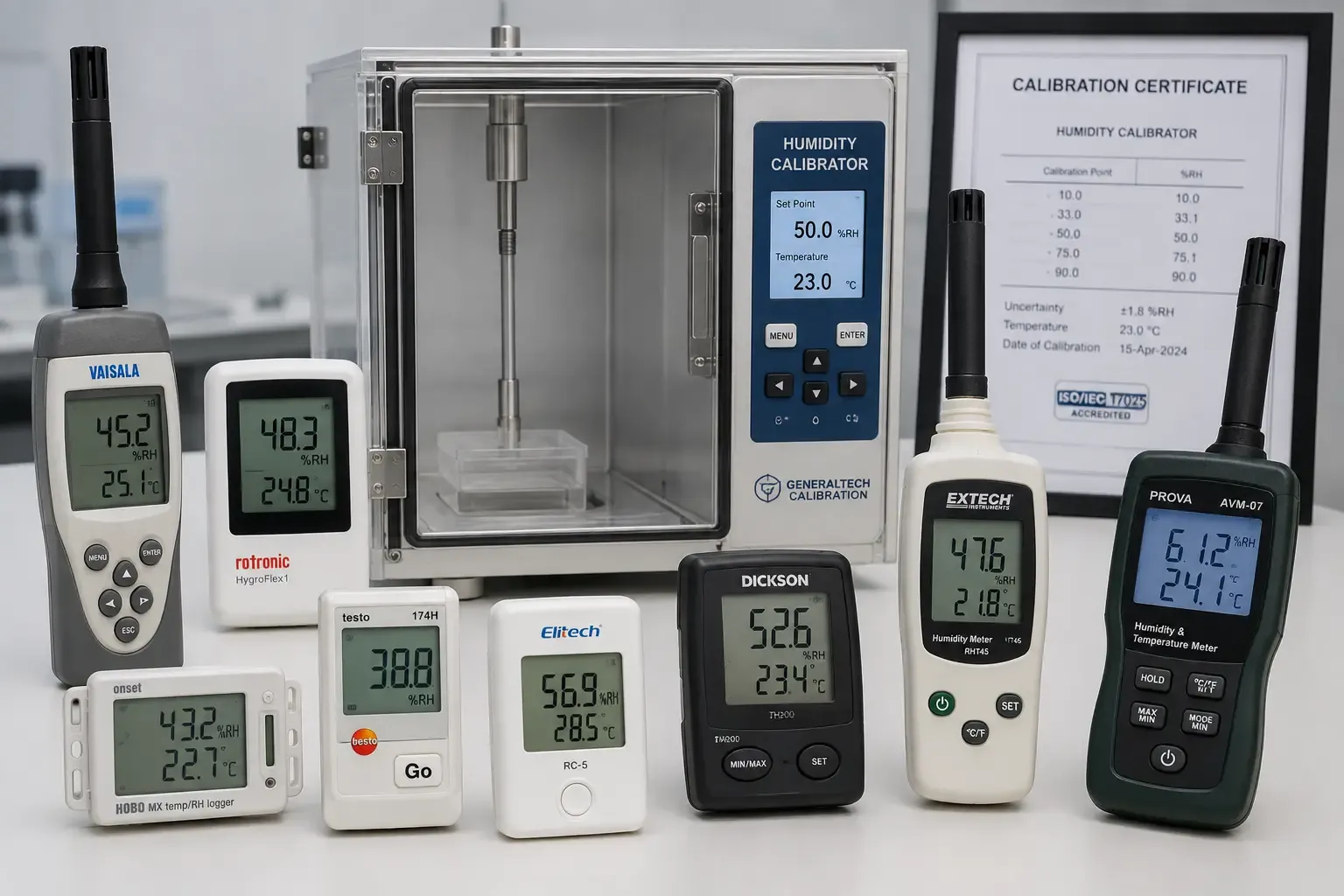
Humidity calibration spans a broader instrument category than most facilities initially expect, covering hygrometers, thermohygrometers, hygrothermographs, humidity generators, dew point hygrometers, humidity chambers, humidity and temperature transmitters, dewpoint meters, chart recorders, and data loggers.
Hygrometers and Thermohygrometers
The most common humidity measuring instruments, ranging from simple handheld units to precision bench-top devices, often combining humidity and temperature measurement in a single instrument.
Dew Point Hygrometers and Dewpoint Meters
Measure the temperature at which air becomes saturated with moisture, a particularly precise method of humidity measurement used where tighter accuracy is required than standard relative humidity sensors can provide.
Humidity Generators and Humidity Chambers
Used both as calibration reference equipment and as environmental test equipment in their own right, humidity chambers create controlled humidity conditions for product testing, while humidity generators produce precisely known reference humidity levels used in calibrating other instruments.
Humidity and Temperature Transmitters
Fixed installation instruments feeding continuous humidity data into building management systems, environmental monitoring networks, or process control systems, common in pharmaceutical storage, data centers, and controlled manufacturing environments.
Chart Recorders and Data Loggers
Continuous monitoring devices tracking humidity over time, essential for facilities needing to demonstrate sustained environmental compliance rather than a single point-in-time reading, particularly relevant for regulated storage environments.
How Humidity Calibration Actually Works
The calibration process generally follows this structure, adapted to the specific instrument type:
- Visual inspection of the sensor, housing, and any protective membrane or filter for contamination or damage
- Exposure to a precisely controlled reference humidity environment, generated using a humidity generator, salt solution reference method, or calibrated chamber
- Allowing the instrument to stabilize at each reference point, since humidity sensors typically respond more slowly than temperature or pressure sensors
- Recording the instrument's reading at each reference point and comparing against the known reference humidity level
- Testing across multiple points spanning the instrument's operating range, since accuracy can vary meaningfully between low, mid, and high humidity levels
- Documenting results, including the measurement uncertainty, which tends to be larger for humidity calibration than for many other measurement disciplines given the inherent complexity of generating precise reference conditions
Environmental Mapping: Why It Matters Alongside Calibration
Environmental mapping and calibration of hygrometers, data loggers, and climate chambers matters specifically for sensitive operations where humidity uniformity across a space, not just accuracy at a single sensor location, determines compliance. Environmental mapping studies characterize how humidity actually varies throughout a storage room, warehouse, or chamber, identifying zones of higher or lower humidity that a single sensor location might not represent.
This mapping directly informs where humidity sensors and data loggers should be positioned for genuinely representative monitoring. A perfectly calibrated hygrometer placed in an unrepresentative corner of a storage room can still produce misleading data about actual product storage conditions elsewhere in that same space, which is exactly why mapping and calibration work together rather than substituting for one another.
Industries That Depend Most on Humidity Calibration
While humidity control matters broadly, a few sectors depend on it with particular intensity:
- Pharmaceuticals and life sciences, where humidity directly affects medication stability and shelf life
- Food and beverage processing, where moisture content influences both product quality and food safety compliance
- Museums, archives, and cultural heritage storage, where humidity swings can cause irreversible material damage
- Data centers and electronics manufacturing, where humidity extremes affect equipment reliability and static discharge risk
- HVAC and building management, where humidity control ties directly into occupant comfort and mold prevention
ISO 17025 Accredited Humidity Calibration
Our humidity calibration services cover hygrometers, data loggers, humidity chambers, and transmitters under full EIAC ISO 17025 accreditation, supporting environmental mapping and calibration for sensitive storage and process operations across the UAE.
What a Humidity Calibration Certificate Should Include
A properly issued calibration certificate should clearly document:
- The specific instrument make, model, and serial number
- Measurement results at each tested humidity reference point
- Stated tolerance and pass or fail status at each point
- The measurement uncertainty associated with the calibration, along with the reference method used
- Traceability details for the humidity generator or reference standard used
- The accreditation body and standard the issuing laboratory operates under
How Often Should Humidity Instruments Be Calibrated
General guidance for calibration frequency includes:
- Annual calibration as a standard baseline for general facility monitoring instruments
- More frequent calibration for hygrometers used in pharmaceutical, food, or archival storage where humidity compliance is closely audited
- Immediate recalibration after any suspected sensor contamination, physical damage, or unexplained reading drift
- Periodic environmental mapping review whenever a storage space's layout, contents, or HVAC configuration changes meaningfully
Frequently Asked Questions
Why is humidity calibration considered more complex than temperature calibration? Humidity is typically measured indirectly, through electrical capacitance, resistance, or temperature differential methods, and generating a precisely known reference humidity level for calibration is inherently more complex than generating a known temperature or pressure reference.
What is the difference between a hygrometer and a dew point hygrometer? A standard hygrometer measures relative humidity directly, while a dew point hygrometer measures the temperature at which air becomes saturated with moisture, offering a different and often more precise measurement approach for applications requiring tighter accuracy.
Why does environmental mapping matter alongside humidity calibration? Mapping identifies how humidity varies across a physical space, informing where sensors should be positioned for representative monitoring. A calibrated sensor in the wrong location can still produce misleading data about conditions elsewhere in the same space.
How often should humidity chambers be calibrated? Humidity chambers used for product testing typically require calibration on a schedule matching their criticality, often annually as a baseline, though facilities relying on chamber testing for regulatory submissions may calibrate more frequently to support audit requirements.
Which industries need the most frequent humidity calibration? Pharmaceuticals, food and beverage processing, and archival or museum storage typically require the most frequent and rigorous humidity calibration, given how directly humidity affects product stability, safety, and material preservation in these sectors.
Closing Thoughts
Humidity calibration services UAE pharmaceutical, food, and archival storage facilities depend on protect against a measurement discipline that's easy to overlook precisely because it's less intuitive than temperature or pressure. Whether calibrating a single handheld hygrometer or mapping an entire climate-controlled storage facility, accredited calibration backed by proper environmental mapping is what keeps humidity-sensitive operations genuinely defensible.
To schedule humidity or broader environmental calibration across the UAE, reach out through the General Tech Services contact page, or explore the full range of ISO 17025 accredited calibration disciplines covering humidity, temperature, pressure, and electrical measurement.