Manometers measure some of the smallest pressure differentials found in any industrial or building system, often just fractions of an inch of water column, yet those tiny numbers control decisions with real consequences: whether a cleanroom is holding negative pressure correctly, whether an HVAC system is balanced, or whether a filter needs replacing before it fails. At this scale, even a small calibration error can flip a pass into a fail, or worse, mask a fail as a pass.
This is why manometer calibration UAE facilities working in HVAC, cleanroom validation, and low-pressure process monitoring rely on has to be handled with the same rigor as higher-pressure calibration work, not treated as an afterthought because the numbers involved look small. This guide covers how manometer calibration works across different instrument types, what traceability actually means at these pressure ranges, and how often recalibration should happen.
Why Low Pressure Calibration UAE Facilities Need Is Its Own Challenge
Low pressure calibration UAE technicians perform is technically more demanding than it might appear, precisely because the measurement ranges involved are so small. A few factors make this true:
- At low differential pressures, even minor temperature fluctuations or air currents in the calibration environment can introduce measurable error
- Reference standards used for low-pressure calibration need proportionally tighter uncertainty than would be acceptable at higher pressure ranges
- Leaks in tubing or fittings that would be negligible at higher pressures can meaningfully distort readings at the fractional inch-of-water-column level many manometers operate within
- Sensor resolution limits become a real constraint, since some instruments simply cannot resolve the fine gradations needed for certain low-pressure applications
A calibration laboratory experienced in general industrial pressure work does not automatically have the setup or expertise needed for accurate low-pressure manometer verification. This is a distinct skill within pressure metrology.
U-Tube Manometer Calibration
U-tube manometer calibration covers the oldest and most fundamentally simple pressure measurement device still in regular use, relying on the height difference of a liquid column, typically water or mercury, to indicate pressure. Calibration for this type verifies:
- Accuracy of the liquid column reading against a certified reference standard
- Tube cleanliness and absence of trapped air bubbles, which can distort the meniscus and reading accuracy
- Correct fluid density and temperature compensation, since liquid density changes with temperature and affects the pressure-to-height relationship
- Verticality and mounting, since a tilted U-tube manometer will produce systematically incorrect readings
Despite their simplicity, U-tube manometers remain trusted reference-grade instruments in many laboratory settings precisely because their operating principle is so fundamentally traceable to physical constants.
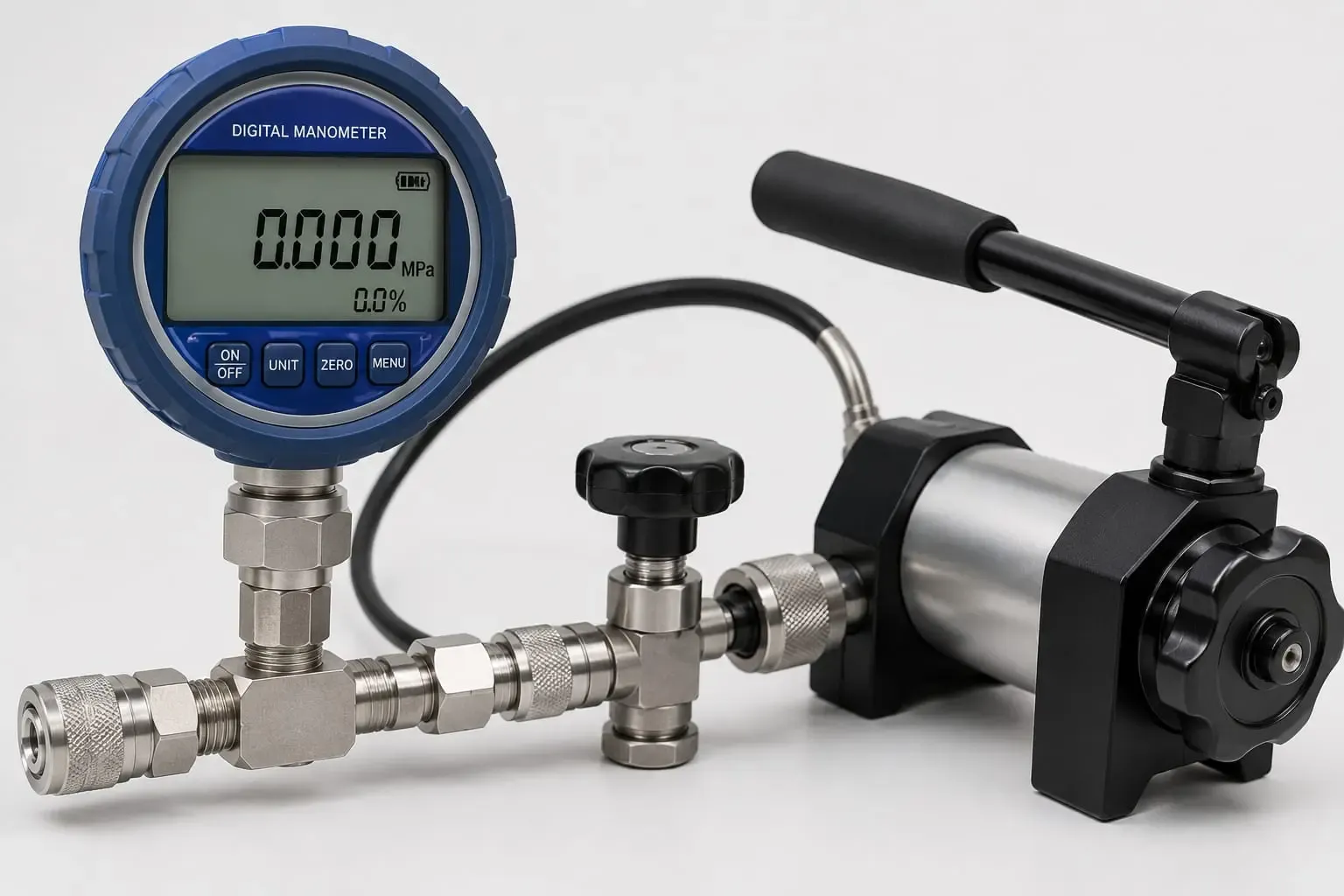
Digital Manometer Calibration
Digital manometer calibration extends beyond the pressure sensing element to cover the electronic components that translate pressure into a displayed digital reading. This includes:
- Display accuracy verification at multiple points across the instrument's range
- Zero-setting function reliability
- Battery-related drift, since declining battery voltage can subtly affect accuracy before a unit fails outright
- Response time and stability, particularly relevant for digital manometers used in dynamic HVAC balancing work where readings need to settle quickly and accurately
Digital manometers offer faster readings and easier data logging than traditional liquid-column instruments, but the added electronics introduce failure points that purely mechanical designs do not have, making scheduled calibration equally important.
Differential Pressure Manometer Testing
Differential pressure manometer testing applies specifically to instruments measuring the pressure difference between two points, commonly used for filter monitoring, duct balancing, and cleanroom pressure differential verification. This testing needs to account for:
- Accuracy across the full differential range the instrument is rated for
- Static pressure effects, where high pressure applied equally to both ports can subtly shift accuracy even though the differential itself remains constant
- Response consistency whether pressure is increasing or decreasing toward a given test point
Differential manometers used in cleanroom or pharmaceutical environments often carry particularly tight tolerance requirements, since pressure differentials in these settings directly relate to contamination control.
How Manometer Calibration Actually Works
Regardless of manometer type, the calibration process generally follows a consistent structure:
- Visual inspection of the instrument, tubing, and fittings for damage, contamination, or leaks
- Zero-point verification under stable, controlled environmental conditions
- Measurement against a certified reference standard at multiple points across the instrument's rated range
- Recording of deviation at each point compared against manufacturer tolerance
- Documentation of "as found" and "as left" results, including any adjustment performed
Because of the low-pressure sensitivities involved, this process is typically performed in an environment shielded from drafts, with careful attention to temperature stability throughout the calibration.
HVAC Manometer Calibration
HVAC manometer calibration deserves specific attention because these instruments directly influence building performance, energy efficiency, and indoor air quality decisions. Facilities managers and HVAC contractors use manometers for:
- Air filter differential pressure monitoring, indicating when a filter needs replacement
- Duct static pressure verification during system balancing and commissioning
- Building pressurization checks, particularly important in healthcare, pharmaceutical, and laboratory environments
- Fan and blower performance verification
An uncalibrated manometer in HVAC work can lead to premature filter replacement, missed filter changes that strain equipment, or incorrectly balanced systems that waste energy or fail to maintain required pressure relationships between spaces.
Traceable Pressure Calibration UAE Facilities Can Rely On for Audits
Traceable pressure calibration UAE compliance frameworks require means the reference standards used for your manometer calibration can themselves be traced, through a documented and unbroken chain, back to a national or international measurement standard. Without this traceability, a calibration certificate offers no real defensible evidence during an audit, regardless of how accurate the numbers appear.
ISO 17025 Manometer Calibration and Measurement Uncertainty
ISO 17025 manometer calibration requires the issuing laboratory to calculate and report a measurement uncertainty alongside every result, not just a pass or fail outcome. Given how small the measurement ranges involved often are, this uncertainty figure matters more here than it might for higher-pressure instruments, since a small stated uncertainty relative to the reading can be the difference between a defensible pass and a result too close to call.
Our pressure calibration services cover manometers alongside gauges and transducers across the full pressure spectrum from vacuum through 40,000 PSI, all performed under full EIAC ISO 17025 accreditation.
Manometer Calibration Frequency
There is no single universal interval, but general guidance for manometer calibration frequency includes:
- Annual calibration as a standard baseline for manometers used in general HVAC and facilities monitoring
- Six-month intervals for manometers used in cleanroom, pharmaceutical, or other tightly regulated environments where pressure differential compliance is continuously audited
- Immediate recalibration after any suspected leak, physical damage, or unexplained reading inconsistency
- Verification against a portable reference standard between full calibration cycles for critical differential pressure applications, catching drift early
What a Manometer Calibration Certificate Should Include
A properly issued manometer calibration certificate should clearly state:
- The specific instrument make, model, and serial number
- Measurement results at each tested point compared against the reference standard
- Stated tolerance and pass or fail status at each point
- The measurement uncertainty for the calibration
- Traceability details for the reference standards used
- The accreditation body and standard the issuing laboratory operates under
If a certificate does not clearly state uncertainty at the specific low-pressure ranges tested, it is worth confirming directly with the provider before relying on it for compliance purposes.
Choosing an Accredited Calibration Laboratory UAE Facilities Can Trust for Manometer Work
Not every pressure calibration provider has the setup needed for accurate low-pressure manometer verification. Before selecting a provider, confirm:
- Reference standards specifically suited to low differential pressure ranges, not just general industrial pressure equipment
- Current EIAC accreditation to ISO/IEC 17025 covering the specific pressure range your manometers operate within
- A controlled calibration environment shielded from drafts and temperature fluctuations
- Documented measurement uncertainty appropriate to the fine measurement scale involved
- Experience with your specific application, whether HVAC balancing, cleanroom monitoring, or general process work
Our team at General Tech Services works across pressure, temperature, dimensional, and electrical calibration disciplines from a single EIAC and ENAS accredited ISO 17025 laboratory in Sharjah, with manometers and low-pressure instruments calibrated using reference standards suited to their specific measurement scale. On-site verification is also available for manometers integrated into fixed HVAC or process systems that are impractical to remove for lab testing.
Frequently Asked Questions
How often should a manometer be calibrated? Most manometers used in general HVAC or facilities work should be calibrated annually, with six-month intervals recommended for cleanroom, pharmaceutical, or other applications where pressure differential compliance is closely monitored.
Why is low-pressure calibration harder than higher-pressure calibration? At low pressure ranges, small environmental factors like temperature fluctuation, air currents, and minor leaks that would be negligible at higher pressures can meaningfully distort readings, requiring more controlled calibration conditions and finer reference standards.
Do digital manometers need different calibration than U-tube manometers? Yes. Digital manometers require additional checks for display accuracy and battery-related drift alongside pressure sensing accuracy, while U-tube manometers require verification of fluid density, temperature compensation, and correct vertical mounting.
What is the difference between a manometer and a general pressure gauge for calibration purposes? Manometers typically measure much smaller pressure ranges, often fractions of an inch of water column, requiring calibration reference standards and environmental controls suited to that fine measurement scale, unlike general pressure gauges calibrated across wider industrial ranges.
Can a manometer be calibrated on-site rather than sent to a laboratory? In many cases, yes, particularly for manometers integrated into fixed HVAC ductwork or building systems where removal would be impractical, though the calibration environment still needs to be reasonably stable and shielded from drafts for accurate low-pressure results.
Closing Thoughts
Manometer calibration UAE HVAC, cleanroom, and process facilities depend on protects measurement accuracy at a scale where small errors carry outsized consequences. Whether you rely on a traditional U-tube instrument or a digital differential manometer for filter and duct monitoring, traceable calibration performed by a laboratory experienced specifically in low-pressure work is what keeps those fine measurements defensible.
For manometer or broader pressure calibration needs across the UAE, reach out through the contact page to discuss your requirements, or browse the complete list of ISO 17025 accredited calibration services spanning pressure, temperature, dimensional, and electrical disciplines.