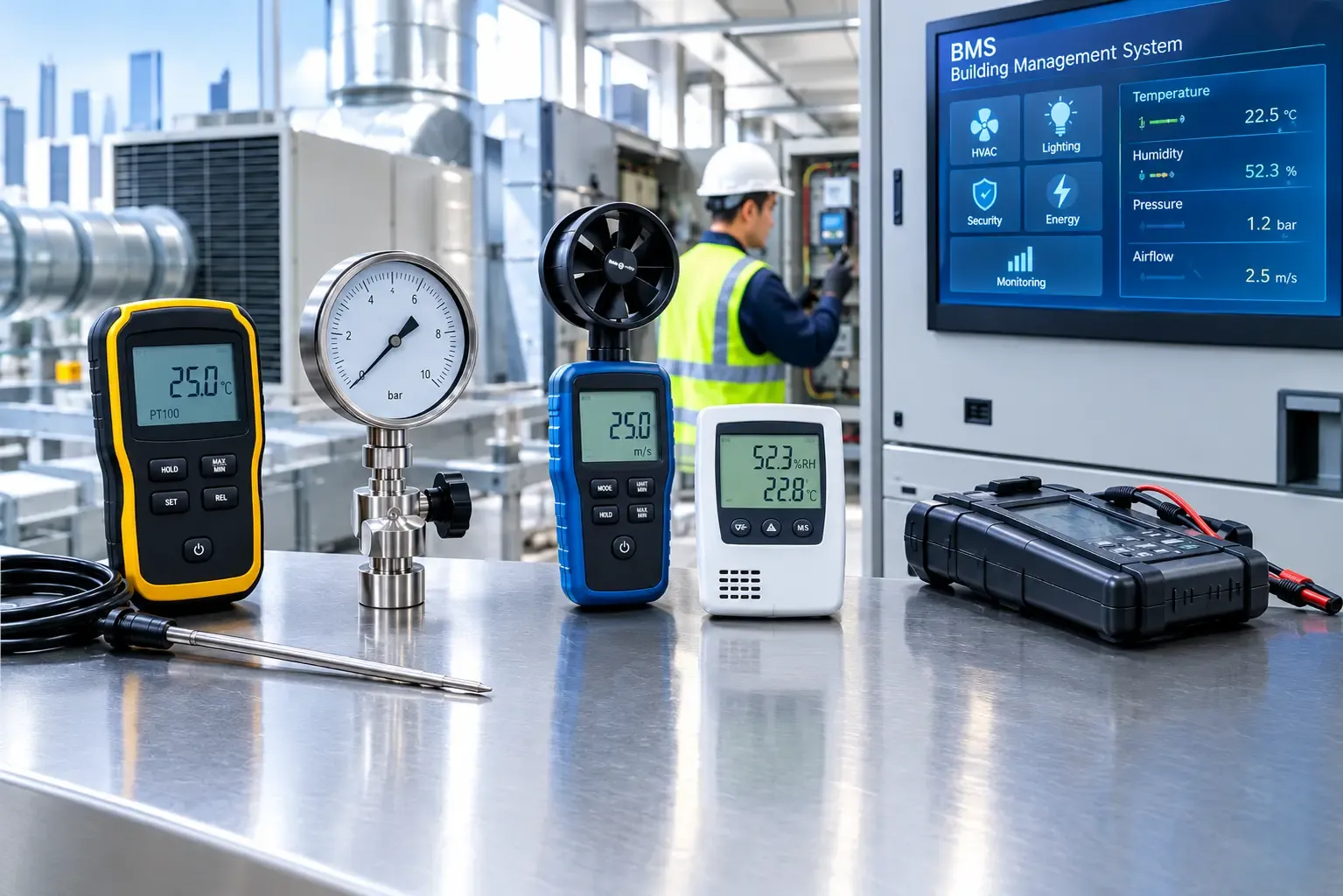
In the UAE, cooling is not a comfort feature, it is the single largest energy load in most buildings. A hotel, hospital, mall or office tower runs chillers, pumps and air handlers for most of the year, and the building management system decides how hard they work by reading hundreds of sensors. Those sensors are rarely questioned. If the system says the room is 22°C, everyone assumes it is.
A BMS can only be as good as the sensors feeding it. A temperature sensor that reads 1.5°C high makes the system overcool a space. A drifting duct pressure sensor makes a fan run harder than it needs to. This guide explains why HVAC and BMS calibration in the UAE protects both comfort and energy cost, which instruments matter most, and how to build a practical calibration routine for building services teams.
Why BMS Sensors Drift and What It Costs
Building sensors live in difficult conditions: heat, dust, humidity, vibration and years of continuous operation. They drift quietly, and the BMS keeps acting on the wrong numbers. The effects are familiar to every facilities team:
- Overcooling, because a sensor reading high pushes the system to cool more than the real space needs
- Comfort complaints from zones that read fine on the system but feel wrong to occupants
- Wasted fan and pump energy, when pressure or flow sensors misreport demand
- Humidity problems, including condensation and mold risk in spaces that read drier than they are
- Hunting and instability, where a noisy or drifting sensor makes valves and dampers move constantly
- Faulty energy data, which undermines any attempt to measure savings or benchmark performance
Because the BMS display looks authoritative, these problems are often blamed on the equipment rather than the sensor.
The Instruments That Matter Most
Temperature Sensors
Space, return air, supply air, chilled water and condenser water temperatures drive control decisions. Chilled water supply and return sensors are especially critical, because the temperature difference between them (delta-T) tells operators how well the system is performing. Small errors in either sensor distort that picture. See our guide to temperature calibration for how these sensors are verified.
Humidity Sensors
Relative humidity sensors control dehumidification, protect sensitive spaces and guard against mold. They drift more than most people expect, particularly in dusty or contaminated air. Our guide to humidity calibration explains how they are checked.
Pressure and Differential Pressure
Duct static pressure sensors control fan speed, filter differential pressure sensors flag when filters need changing, and room pressure sensors maintain pressure relationships in hospitals and laboratories. These readings are small, so small errors matter. See our guide to manometer calibration and our guide to pressure gauge calibration.
Flow Measurement and Energy Meters
Chilled water flow meters and BTU energy meters are used for system balancing, performance monitoring and, in buildings connected to district cooling, for billing. A BTU meter works by combining a flow measurement with a matched pair of temperature sensors, so its accuracy depends on both. Calibration of the flow meter and the temperature pair is what makes the energy reading, and any bill based on it, defensible. See our guide to flow meter calibration.
Gas and Air Quality Sensors
Carbon dioxide and other gas sensors drive demand-controlled ventilation and indoor air quality monitoring, and they are among the more drift-prone sensors in a building. Where gas detection protects safety, such as in plant rooms and car parks, see our guide to gas detector calibration.
Electrical Measurement and Drives
Variable frequency drives control fan and pump speeds in modern HVAC systems, and the electrical instruments used to commission and troubleshoot them need to be accurate too. See our guide to clamp meter calibration and our overview of VFDs in UAE industry.
Test and Balance Instruments Need Calibration Too
Testing, adjusting and balancing, often called TAB, sets air and water flows so a system performs as designed. The instruments used for it, such as manometers, thermometers, hygrometers and flow measuring devices, directly shape the settings made. A balancing contractor using an uncalibrated instrument can leave a system set up incorrectly for years. Facilities teams commissioning or recommissioning a building can reasonably ask for current calibration certificates for the instruments used.
Two Layers: Field Sensors and Reference Instruments
A practical program separates two types of instrument.
Field sensors are fixed in the building, such as BMS temperature, humidity and pressure sensors. These are numerous and often difficult to remove, so many facilities check them in place by comparing them against a calibrated reference instrument, and correct or replace those that are out of tolerance.
Reference instruments are the portable calibrated instruments used to check the field sensors and to commission and balance systems. These should be calibrated by an accredited laboratory with traceable certificates, since the quality of every field check depends on them.
Putting the reference layer on a proper calibration schedule is the most cost-effective step a facilities team can take, because one accurate reference can validate hundreds of field sensors.
Where Calibration Matters Most
Not every building needs the same level of attention. The priority areas tend to be:
- Hospitals and laboratories, where pressure relationships, temperature and humidity are safety and compliance issues
- Data centers, where cooling reliability and efficiency are critical
- Hotels and malls, where comfort complaints and energy cost are visible and constant
- Pharmaceutical and food facilities, where HVAC is part of product quality
- Buildings billed through district cooling, where metering accuracy has direct financial impact
- Buildings pursuing green building or energy performance targets, where credible measurement is essential
Thermal surveys also help identify electrical and mechanical issues around HVAC plant; see our guide to thermal imaging services.
How Often Should HVAC and BMS Instruments Be Calibrated
There is no single schedule, but a sensible baseline is:
- Calibrate reference instruments annually, as a common baseline, with certificates retained
- Check critical field sensors, such as chilled water temperature, room pressure and humidity in controlled spaces, at least annually
- Check less critical comfort sensors on a longer cycle, or on a sampling basis
- Check immediately when comfort complaints, energy anomalies or unexplained trends appear
- Use as-found results to adjust intervals over time
Our guide to calibration frequency in the UAE explains how to set and review intervals.
Calibration Support for Building Services Teams
Our laboratory is accredited by EIAC (LB-CAL-004) and ENAS (NAL 240) across temperature, humidity, pressure, flow and electrical disciplines, so a facilities team can cover its reference instruments through one provider. Because many HVAC instruments are fixed or hard to move, on-site calibration is available. Explore the full range of calibration disciplines.
Frequently Asked Questions
Do BMS sensors need calibration? Yes. They drift over time, and because the BMS acts on whatever they report, drift causes overcooling, wasted energy and comfort problems, so they should be checked against calibrated references.
What is a reference instrument in HVAC calibration? A portable calibrated instrument, such as a reference thermometer, hygrometer or manometer, used to check fixed sensors and to commission and balance systems.
Why does BTU meter calibration matter? A BTU meter combines flow and a matched pair of temperature sensors, so errors in either distort the energy reading, which affects performance monitoring and billing in district cooling.
How often should HVAC sensors be calibrated? Annually is a common baseline for reference instruments and critical field sensors, with longer cycles for less critical sensors and immediate checks when anomalies appear.
Can HVAC instruments be calibrated on-site? Yes. On-site calibration suits fixed installations and equipment that cannot be removed from service.
Closing Thoughts
HVAC and BMS calibration in the UAE protects the largest energy load in most buildings and the comfort of the people inside them. Keeping an accredited set of reference instruments, checking critical sensors against them on a schedule, and acting on as-found results keeps the building management system working from facts instead of drifting assumptions.
To discuss calibration for your building services instruments, reach out through the General Tech Services contact page.