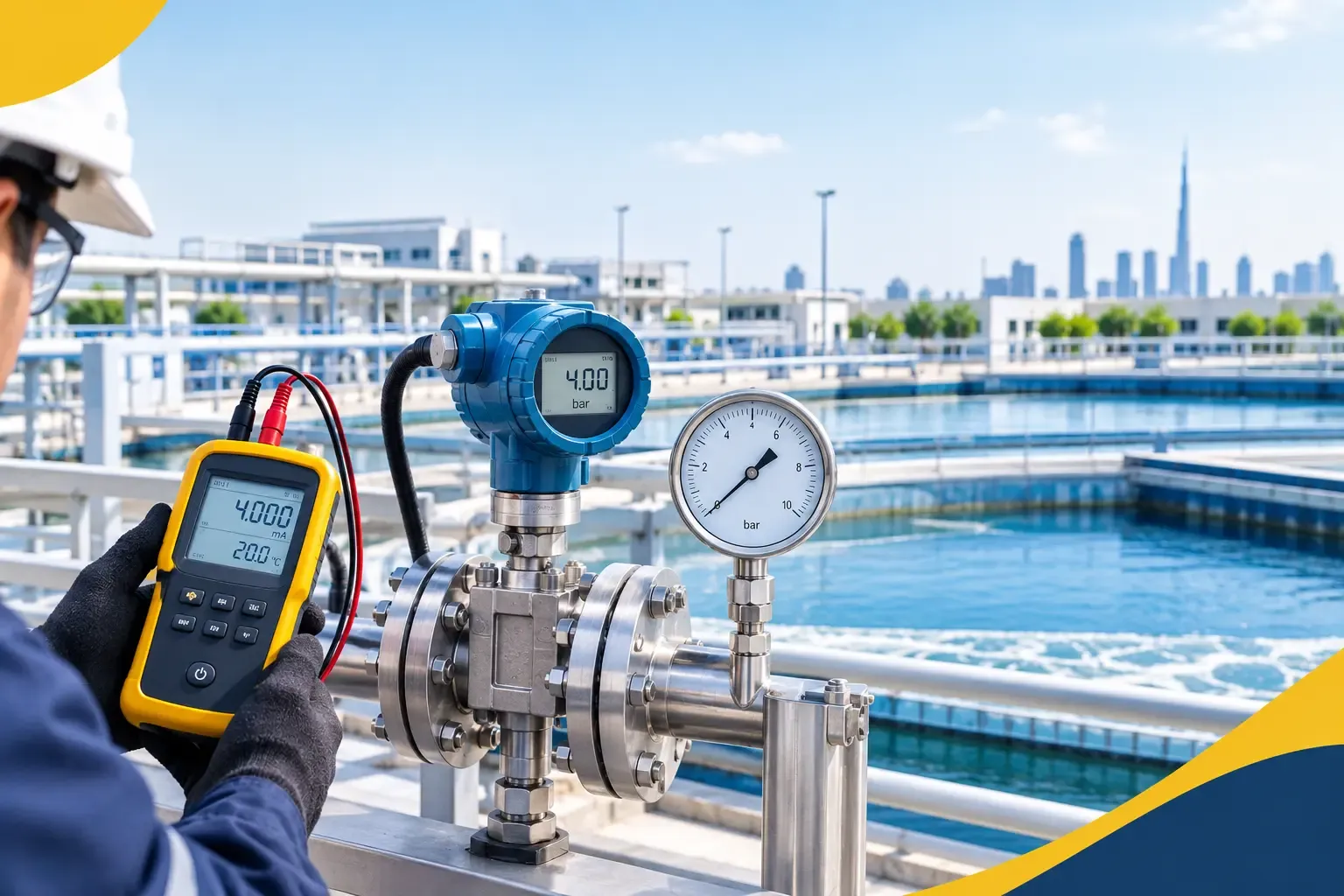
In a water treatment plant, nearly every important decision is made by an instrument. A pH probe tells the dosing system how much chemical to add. A flow meter tells operators how much water is leaving the plant. A pressure transmitter tells the SCADA system whether a pump is performing. People rarely look at the sensors themselves. They look at the numbers on the screen and act.
That makes calibration a public health and cost issue as much as a technical one. This guide explains why calibration for utilities and water treatment plants in the UAE matters, which instruments carry the most risk, and how plant teams can build a calibration program that protects water quality, supports compliance and reduces lost water.
Why Accuracy Matters More in Water Than Most People Realize
Water treatment is a continuous process with tight margins, and small measurement errors have outsized effects:
- Disinfection and chemical dosing depend on accurate flow and analytical readings. Overdosing wastes chemicals and can cause quality issues, while underdosing can leave water inadequately treated
- pH control affects coagulation, disinfection effectiveness and pipe corrosion
- Flow measurement drives dosing ratios, process control and the plant's water balance
- Pressure monitoring protects pumps, membranes and distribution networks from damage
- Regulatory reporting depends on records being credible, since effluent and drinking water results are reviewed by authorities
A drifting instrument rarely causes an obvious failure. It shifts the process slightly, wastes money steadily, and leaves records that cannot be fully trusted.
The Instruments That Matter Most
Flow Meters
Flow meters measure raw water intake, process flows, chemical dosing, treated water output and distribution. Electromagnetic, ultrasonic and mechanical meters all drift in different ways. Bulk and district meters also feed the water balance, so errors hide real losses. See our guide to flow meter calibration for how different meter technologies are verified.
pH and Laboratory Instruments
pH meters in the field and the laboratory guide treatment control and compliance reporting. They need regular buffer calibration and periodic accredited verification. Laboratory balances, pipettes and burettes support analytical testing. See our guides to pH meter calibration and volumetric calibration.
Pressure and Level Transmitters
Pressure transmitters on pump discharge, filter differential pressure, reverse osmosis feed lines and distribution networks feed control loops and alarms. Their output signals drift, and the signal chain between transmitter and control system needs checking too. See our guide to pressure transmitter calibration.
Gas Detectors
Treatment sites can involve chlorine and other hazardous gases, along with confined spaces such as wet wells and sewage pumping stations where hydrogen sulfide and oxygen deficiency are real dangers. Gas detectors protecting workers need both routine bump tests and full calibration. See our guide to gas detector calibration.
Electrical and Motor Control Equipment
Pumps run for long hours on motors controlled by drives and starters. Electrical test instruments used to commission and troubleshoot them should be accurate, and power quality affects motor life. See our guides to VFDs in UAE industry and power quality analysis.
Online Analyzers
Many plants use online analyzers for parameters such as residual disinfectant, turbidity and conductivity. These are typically verified against traceable standard solutions or reference methods, and the reagents used must be in date and traceable. Confirm with your calibration provider which analyzer types and parameters fall within their accredited scope.
Water Loss and the Role of Accurate Metering
Water loss is a major concern for utilities. The gap between water produced and water billed, often called non-revenue water, includes leaks, theft and metering errors. Inaccurate meters can make losses look larger or smaller than they really are, which sends engineering effort in the wrong direction.
Calibrated bulk and district meters give utilities a trustworthy water balance, so teams can tell a real leak from a metering error. This is one of the most direct financial returns on a utility's calibration spend.
The Signal Chain: Calibrating the Whole Loop
In a SCADA environment, the reading an operator sees has passed through a sensor, a transmitter, a cable, an input card and software. An error can enter at any point. A loop check compares the value at the source with the value displayed at the control room, so faults in the chain, not just in the sensor, are found. Good practice calibrates the transmitter and also verifies the loop end to end.
Setting a Practical Calibration Program
A risk-based program works better than a single schedule:
- List every instrument that influences water quality, safety, dosing or compliance reporting
- Rank them by consequence, with disinfection, dosing and safety instruments at the top
- Calibrate critical instruments at least annually, as a common baseline, with shorter intervals for harsh services
- Use routine checks for field analyzers and gas detectors between formal calibrations
- Keep as-found data so drift trends can be seen and intervals adjusted
- Record everything in an instrument register linked to certificates
Our guide to calibration frequency in the UAE explains how to set and review these intervals.
On-Site Calibration for Fixed Installations
Treatment plants run continuously, and many instruments are installed in pipework, tanks and panels that cannot be removed without disrupting the process. On-site calibration lets reference standards come to the plant, so transmitters, meters and detectors can be verified in place with minimal interruption.
What Auditors and Regulators Look For
Whether the reviewer is an internal auditor, a quality system assessor or a regulator, they commonly look for:
- A register of critical instruments with calibration status
- Calibration certificates from an accredited provider, with traceability and uncertainty
- Evidence of routine verification between calibrations
- Records of action when an instrument failed
- Consistency between calibration dates and the reporting period of compliance data
Calibration Support for Utilities
Our laboratory is accredited by EIAC (LB-CAL-004) and ENAS (NAL 240) to ISO/IEC 17025 across flow, pressure, pH, volumetric, temperature, electrical and other disciplines, so a utility can cover many of its instrument types through one provider. Explore the full range of calibration disciplines.
Frequently Asked Questions
Which instruments in a water treatment plant need calibration most? Flow meters, pH meters, pressure and level transmitters, online analyzers and gas detectors are the highest priority, since they drive dosing, safety and compliance.
Why does flow meter calibration matter for water loss? Metering errors distort the water balance, which can hide real losses or create false ones, so calibrated meters give a reliable picture of where water is actually going.
How often should water treatment instruments be calibrated? Annually is a common baseline, with shorter intervals for harsh services, safety instruments and critical dosing and disinfection control points.
Can calibration be done without shutting down the plant? Often yes. On-site calibration verifies instruments in place, and plants can sequence work so critical processes stay running.
What is a loop check? A loop check compares a value at the sensor with what appears in the control room, verifying the entire signal chain rather than just the sensor.
Closing Thoughts
Calibration for utilities and water treatment plants in the UAE protects water quality, worker safety and the accuracy of the numbers a utility reports and bills on. Ranking instruments by consequence, calibrating the whole signal chain, and working with an accredited provider turns calibration into a tool for reducing waste and proving compliance.
To discuss calibration for your plant, reach out through the General Tech Services contact page.