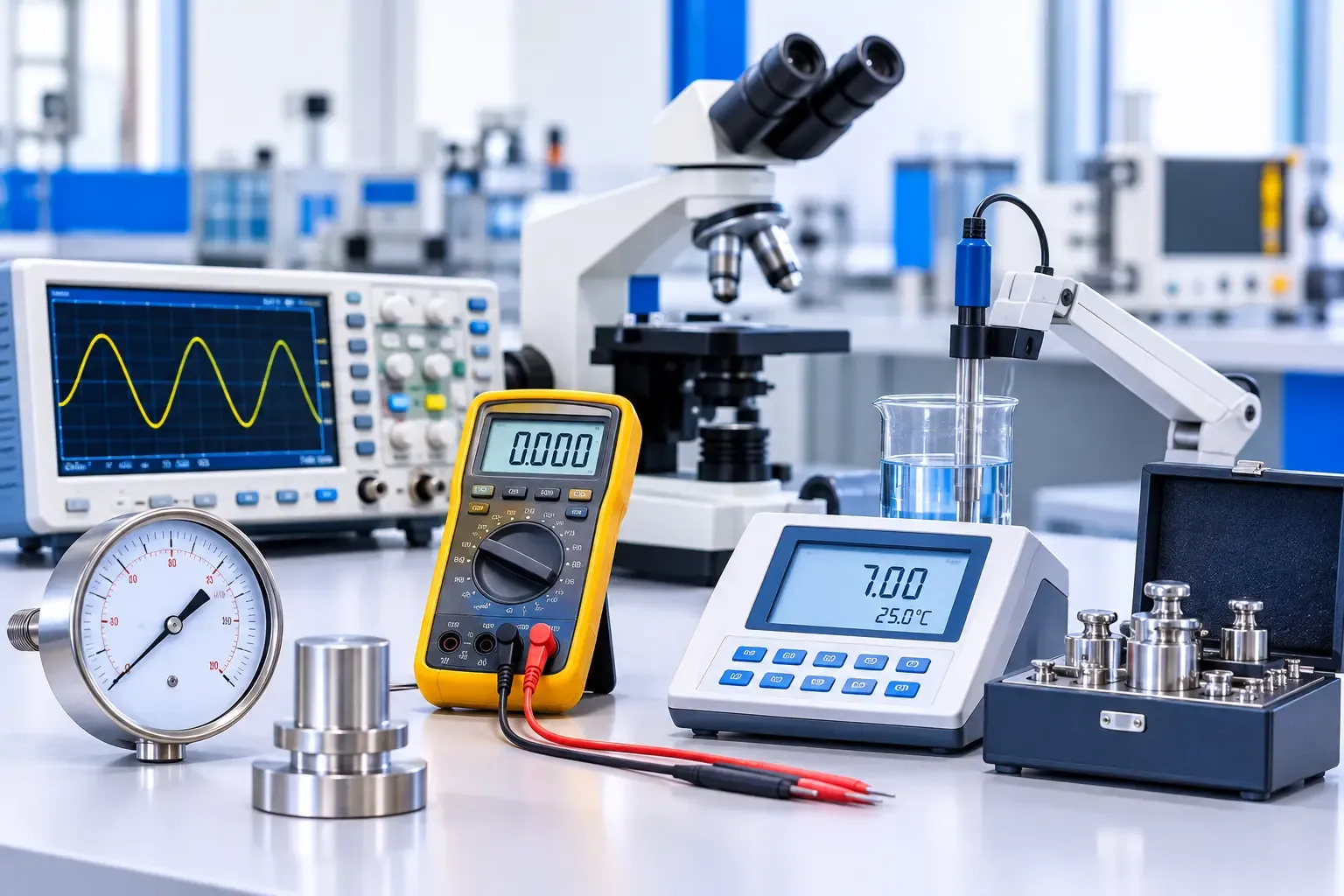
A research result is only as strong as the measurements behind it. A student weighing reagents, a postgraduate running titrations, a lab group storing samples in an ultra-low freezer, an engineering class crushing test specimens: every one of them is trusting an instrument. When that instrument drifts, the damage is not just a wrong number. It can be a failed experiment, an irreproducible result or a paper that can't be defended.
This is why calibration for education and research laboratories in the UAE matters beyond compliance. Universities, technical colleges, research centers and school laboratories all depend on measurement quality, and many also teach it. This guide explains which instruments carry the most risk in academic labs, how teaching and research labs differ, how to plan calibration around the academic calendar, and how to keep a program manageable on a real budget.
Why Academic Labs Need a Calibration Program
Academic labs have some particular challenges:
- Heavy, varied use. Instruments are used by many people with different skill levels, so wear and misuse are more likely
- Reproducibility. Research relies on results that others can reproduce, and calibration supports that by showing the instruments were accurate
- Funding and publication. Funders, journals and collaborators increasingly expect methods and equipment to be documented, and calibration records help
- Accreditation. Some university testing and service laboratories seek ISO/IEC 17025 accreditation, which requires calibrated, traceable equipment
- Teaching value. A lab that practices good calibration teaches good habits to the next generation of scientists and engineers
The Instruments That Matter Most
Balances and Weighing Equipment
Analytical and precision balances are the most used instruments in many labs, and errors flow into every solution and formulation. Balances need routine checks with check weights and periodic accredited calibration. See our guide to mass calibration.
pH Meters
pH meters are used in chemistry, biology, environmental science and food science, and their accuracy depends on buffer calibration and electrode condition. See our guide to pH meter calibration.
Pipettes, Burettes and Volumetric Glassware
Volume delivery accuracy underlies dilutions, titrations and assays, and small errors compound across a series. See our guide to volumetric calibration.
Temperature and Humidity Equipment
Ovens, incubators, water baths, refrigerators and freezers hold samples and drive reactions. Ultra-low freezers and sample storage deserve particular attention because a temperature drift can destroy irreplaceable material without any visible sign. See our guides to temperature calibration, temperature data logger calibration and humidity calibration.
Engineering Teaching and Testing Equipment
Materials testing machines, load cells and force gauges in engineering labs produce data students and researchers rely on. See our guides to load cell calibration and force gauge calibration.
Pressure, Flow and Electrical Instruments
Fluid mechanics, thermodynamics and electrical laboratories use pressure gauges, flow meters and electrical test equipment. See our guide to pressure gauge calibration.
Teaching Labs vs Research Labs
The right level of control differs by lab type.
Teaching labs use instruments for repeated, standard exercises. The priority is consistency and fitness for the teaching purpose. A risk-based approach works well: calibrate balances, pH meters and temperature equipment on a regular schedule, and use simple verification checks, such as check weights and buffer checks, between formal calibrations.
Research labs may depend on specific measurement uncertainty for publishable results, so they may need tighter tolerances, documented uncertainty and more frequent verification for critical instruments. Where results will be published or used for regulatory or commercial purposes, accredited calibration certificates give stronger evidence.
Accredited testing and service labs at universities need full traceability and records that meet ISO/IEC 17025, since their outputs are sold or used for compliance.
Planning Around the Academic Calendar
Academic labs have natural quiet periods, and good planning uses them:
- Calibrate before term starts. Have instruments in date when students arrive
- Use breaks for larger work. Semester breaks and summer are the best time for on-site calibration of fixed equipment
- Batch portable instruments. Send balances, meters and glassware together to reduce downtime and cost
- Keep spares. A calibrated spare balance or thermometer keeps teaching running
- Align with research deadlines. Avoid taking critical instruments out of service just before key experiments or submissions
On-site calibration suits large or fixed equipment such as testing machines, chambers and installed instruments.
Managing Cost
Academic budgets are tight, so calibration needs to be efficient:
- Calibrate instruments by risk, not all at the same interval
- Retire or consolidate rarely used instruments rather than calibrating them all
- Use routine in-house verification to catch drift between formal calibrations
- Group instruments into batches and schedule well ahead
- Consider short-term equipment rental for one-off projects instead of buying instruments that will rarely be used
Records That Support Research and Audits
A simple, controlled record system pays off:
- An instrument register with unique IDs, location, owner and due dates
- Certificates linked to each instrument
- Notes of as-found results and any follow-up when an instrument was out of tolerance
- Labels showing calibration status on each instrument
Our guide to how to get a calibration certificate in the UAE explains what a reliable certificate contains, and our guide to calibration frequency in the UAE helps set intervals. Unfamiliar terms are explained in our calibration glossary.
Calibration Support for Academic Labs
Our laboratory is accredited to ISO/IEC 17025 by EIAC (LB-CAL-004) and ENAS (NAL 240) across mass, pH, volumetric, temperature, humidity, force, pressure, electrical and other disciplines, so one provider can cover most of an academic lab's instruments. Explore the full range of calibration disciplines.
Frequently Asked Questions
Do university labs need accredited calibration? Not always, but accredited certificates give stronger evidence for published research and are expected for ISO/IEC 17025 accredited university testing labs.
What instruments should a teaching lab calibrate first? Balances, pH meters, temperature equipment such as ovens and incubators, and volumetric instruments, since they affect the most experiments.
How often should lab instruments be calibrated? Annually is a common baseline, with more frequent checks for heavily used or critical instruments and routine verification between calibrations.
When is the best time to calibrate in an academic year? Before term starts and during breaks, so instruments are in date for teaching and research and downtime is minimal.
Can calibration be done on campus? Yes. On-site calibration is available for large or fixed equipment such as testing machines, chambers and installed instruments.
Closing Thoughts
Calibration for education and research laboratories in the UAE protects results that others will rely on, and teaches the habits that good science depends on. Prioritizing instruments by risk, planning around the academic calendar, using simple routine checks, and choosing an accredited provider keeps academic labs credible without overwhelming a limited budget.
To discuss calibration for your laboratory, reach out through the General Tech Services contact page.