HACCP is built on a simple idea: identify the points in a process where a hazard can be controlled, set a limit, and monitor it. A cooking core temperature of a certain value, a chiller held below a certain temperature, a pH below a certain level. The entire system rests on one assumption that rarely gets questioned, which is that the instrument doing the monitoring is telling the truth.
If a probe thermometer reads 3°C low, a chicken breast that looked safely cooked may not be. If a chiller sensor drifts upward, a cold room can sit outside its safe range while the display shows a comfortable number. That is why HACCP calibration requirements are not an optional extra for UAE food businesses. They are the foundation that makes every critical control point record believable. This guide covers what HACCP and related standards expect, which instruments matter, and how to build a calibration program that stands up to inspection.
What HACCP and Food Safety Standards Say About Calibration
HACCP itself, as set out in the Codex Alimentarius food hygiene guidance, requires monitoring of critical control points and verification activities that include checking that monitoring equipment is accurate. In practice, food businesses meet this through their food safety management system.
ISO 22000 requires organizations to ensure that monitoring and measuring equipment used for food safety is calibrated or verified at defined intervals against standards traceable to national or international measurement standards, to keep records of that, and to take action when equipment is found out of tolerance.
FSSC 22000 and similar schemes build on ISO 22000 and are commonly required by retailers, hotel groups and export customers.
In the UAE, municipal and emirate-level food control authorities, such as Dubai Municipality and the Abu Dhabi Agriculture and Food Safety Authority, expect food establishments to operate HACCP-based systems and to keep verifiable monitoring records. Exact requirements vary by emirate and business type, so confirm the current rules that apply to your premises. The common thread is simple: records are only credible if the instruments behind them are.
Which Instruments Count as Food Safety Instruments
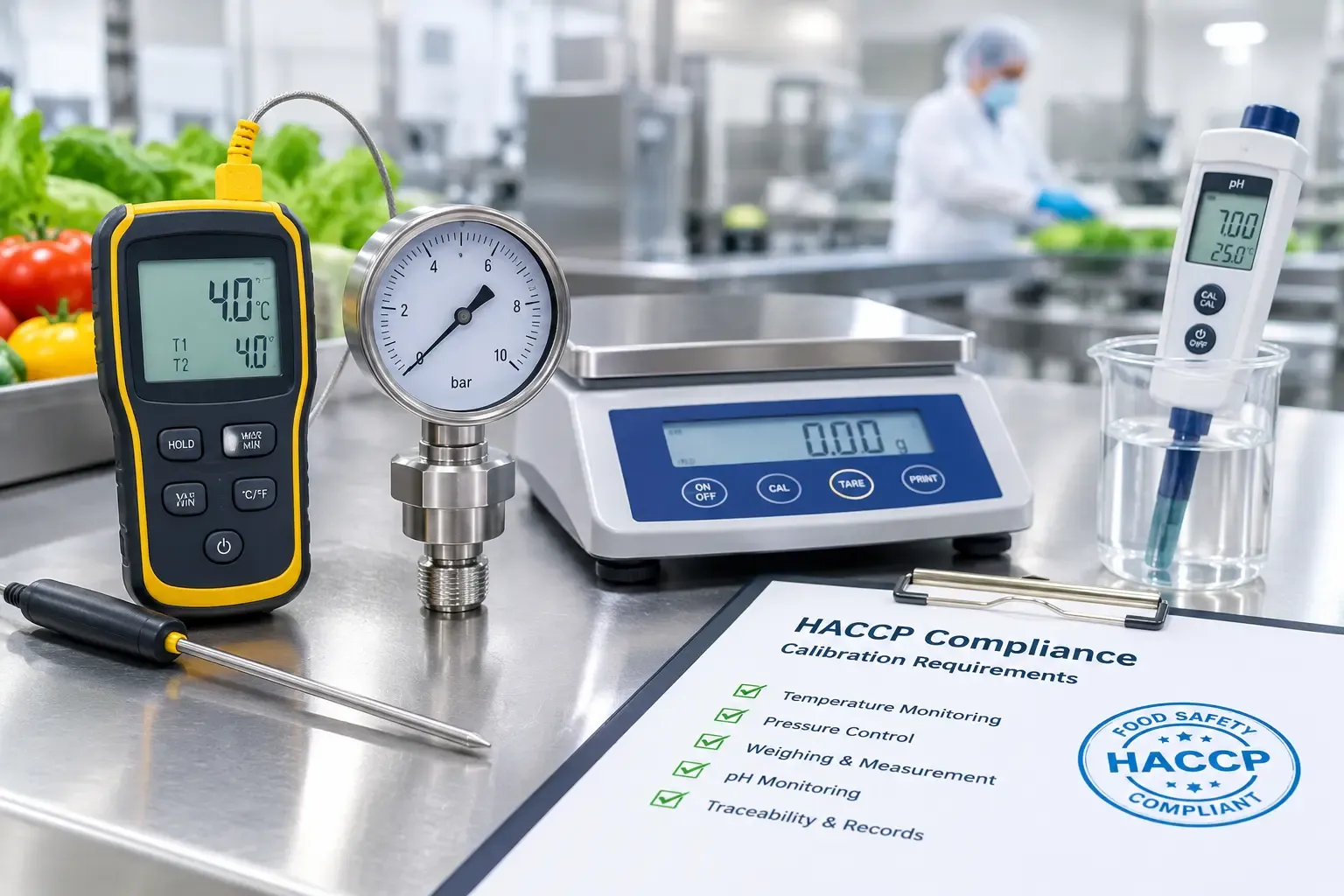
Any instrument whose reading is used to decide whether food is safe, or to prove it was, belongs in the calibration program. The usual list includes:
- Probe and handheld thermometers used for cooking, reheating, hot holding and delivery checks
- Fixed temperature sensors and displays on chillers, freezers, cold rooms, blast chillers and display units
- Data loggers used in storage, transport and process monitoring
- Oven, fryer, pasteurizer and retort temperature sensors tied to thermal process lethality
- pH meters for acidified and fermented products, where pH is a critical limit
- Scales and balances used for ingredient dosing, additive control and net content
- Humidity instruments in ripening, drying and storage areas where moisture control matters
- Water quality instruments where water is part of the process
Instruments used only for information, with no bearing on food safety decisions, can usually be handled with lighter controls, but the decision should be documented rather than assumed.
Critical Limits Show Why Accuracy Matters
Critical limits are typically tight. Common examples used in the industry are cold holding at or below about 5°C, frozen storage at about minus 18°C or colder, hot holding at or above about 60°C, and cooking core temperatures set by the product and process. Check the limits that apply to your products and authority.
When the limit is 5°C and a sensor reads 1.5°C low, a cold room at 6.5°C looks compliant. The gap between a safe and an unsafe product can be a degree or two, which is smaller than the error many uncalibrated sensors carry. The tighter the limit, the more the accuracy of the instrument matters.
In-House Checks Versus Accredited Calibration
Food businesses commonly use a two-layer approach, and understanding the difference helps you design it properly.
In-house verification is a quick routine check performed by staff. The best known example is the ice-point check for thermometers, where a probe is placed in a well-stirred slurry of crushed ice and water and should read very close to 0°C. Boiling-water checks serve a similar role at higher temperatures, adjusted for altitude. These checks are fast, cheap and useful for catching obvious drift between formal calibrations.
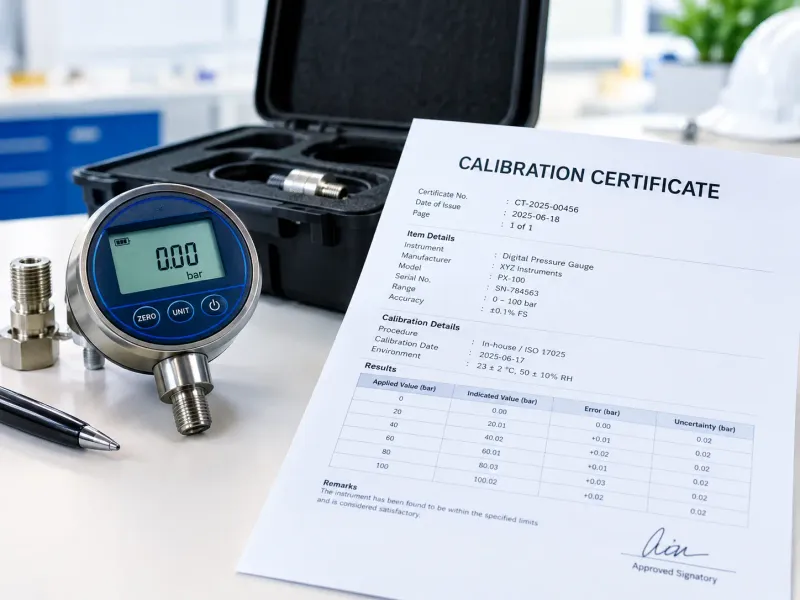
Accredited calibration compares the instrument against a traceable reference standard at several points across its working range and provides a certificate with measurement uncertainty. This is the documented evidence auditors and customers expect for critical instruments, and it is what establishes whether your in-house checks are themselves reliable.
Both layers matter. In-house checks catch problems early, and accredited calibration anchors the whole system to a traceable reference. Our guide to the difference between calibration and verification covers how these concepts relate.
Calibrating the Temperature Instruments
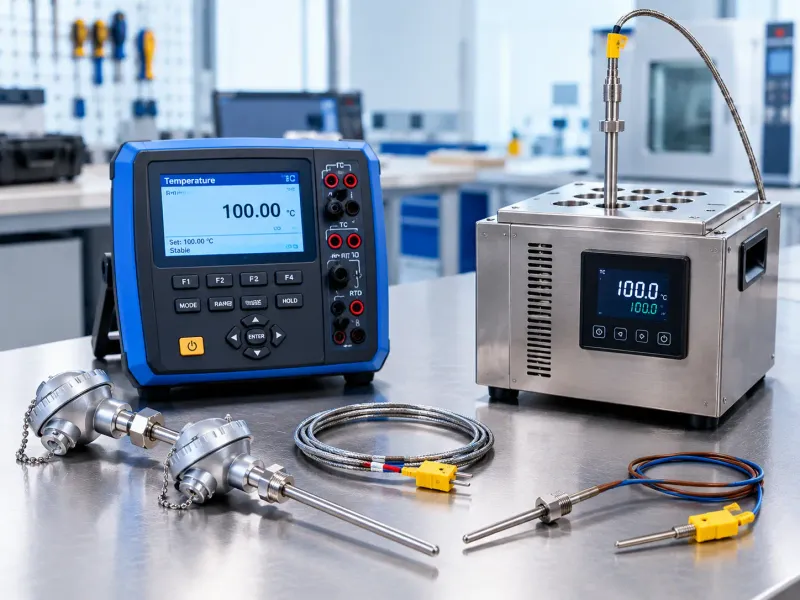
Temperature is the dominant food safety measurement, so most of your calibration effort will be here. Probe thermometers, chiller sensors, oven sensors and loggers should be calibrated at temperatures that match how they are used, for example near the cold holding limit for chiller sensors and near cooking and hot holding temperatures for probes. A single-point check at room temperature says little about accuracy at 5°C or 75°C.
For a full overview of how these sensors are calibrated, see our guide to temperature calibration services in the UAE. For loggers used in storage and transport records, our guide to temperature data logger calibration covers what a defensible program looks like. Where humidity affects product quality, see our guide to humidity calibration.
pH and Weighing Instruments
For products where pH is a critical limit, such as acidified foods and fermented products, the pH meter is a CCP instrument. Meters need regular buffer calibration before use and periodic accredited verification. Our guide to pH meter calibration explains the process.
Scales and balances matter wherever dosing accuracy affects safety or legal net content, for example additives, preservatives and allergen control, or declared pack weights. Our guide to mass calibration covers how weighing equipment is verified.
Setting Calibration Frequencies
There is no single mandated interval, so set intervals by risk and document the reasoning:
- Calibrate every critical instrument before it enters service, to establish a baseline
- Calibrate at least annually, as a common baseline, for CCP instruments
- Shorten the interval for probes used heavily, exposed to heat and washdown, or that have a history of drift
- Use daily or shift-start ice-point checks for handheld probes as a supporting control
- Calibrate immediately after a drop, damage or suspect reading
- Review intervals each year using as-found results
Our guide to calibration frequency in the UAE walks through setting intervals in more detail.
What to Do When an Instrument Is Found Out of Tolerance
An out-of-tolerance result matters more in food than in many sectors because the product may already have been released. The usual response is to remove the instrument, review the records for the period since its last good check, assess whether any product was held outside its safe limits, apply the product disposition your food safety plan requires, correct or replace the instrument, and record all of it. Having as-found data on the certificate is what makes this assessment possible.
Records Auditors Expect to See
When an inspector or customer auditor reviews your calibration controls, they usually look for:
- A register of food safety instruments with unique identification
- Calibration certificates, ideally from an accredited laboratory, with uncertainty and traceability
- Evidence of daily or routine in-house verification checks
- Visible calibration status labels with due dates
- Records of action taken when an instrument failed
- Evidence the plan is reviewed and updated
Keep these together in one place so any single instrument's full history can be produced within minutes.
Calibration Support for Food Businesses
Our laboratory is accredited by EIAC (LB-CAL-004) and ENAS (NAL 240) to ISO/IEC 17025 across temperature, humidity, mass, pH and other disciplines, so a food business can cover its main monitoring instruments through one provider. Where fixed installations such as cold rooms and process equipment cannot be moved, on-site calibration is available. Explore the full range of calibration disciplines.
Frequently Asked Questions
Do HACCP rules require calibration? HACCP requires monitoring of critical control points and verification that monitoring is accurate, and food safety standards such as ISO 22000 require monitoring equipment to be calibrated or verified at defined intervals against traceable standards.
Is an ice-point check enough for a food thermometer? It is a useful routine verification at one point, but it does not replace periodic accredited calibration across the range the thermometer is actually used.
How often should food probe thermometers be calibrated? Annual accredited calibration is a common baseline, supported by routine in-house checks, with shorter intervals for heavily used or drift-prone probes.
Which food safety instruments are most often missed? Fixed chiller and freezer sensors, loggers, oven sensors, pH meters and dosing scales are frequently left out of programs that focus only on handheld thermometers.
What should be done if a thermometer is found out of tolerance? Remove it from use, review product handled since its last good check, apply the disposition your food safety plan requires, then correct or replace the instrument and record the action.
Closing Thoughts
HACCP calibration requirements come down to one principle: a monitoring record is only as trustworthy as the instrument that produced it. Combining routine in-house checks with accredited, traceable calibration, setting intervals by risk, and keeping a clean register of instruments and certificates is what makes a food safety system credible to inspectors, customers and your own team.
To discuss calibration for your food safety instruments, reach out through the General Tech Services contact page.