Dust inside an electrical panel sounds harmless right up until it isn't. Dust is a conductor of electricity, and once it accumulates on busbars, breaker compartments, and switchgear internals, it creates exactly the conditions that lead to tracking, arcing, and eventually flashover. The obvious fix, shutting the panel down to clean it, isn't always an option for facilities running continuous production or critical infrastructure that simply cannot tolerate an unplanned outage.
This is exactly the problem live panel cleaning UAE oil and gas, manufacturing, and critical infrastructure facilities depend on solves. This guide covers how energized equipment can actually be cleaned safely without de-energizing it, the technology behind the process, and which industries benefit most from keeping this on a regular maintenance schedule.
Why Contamination Inside Electrical Panels Is a Genuine Safety Risk
Dust, dirt, salt spray, and general grime accumulating inside a distribution board or switchgear cabinet does more than look untidy. This buildup compromises the dielectric strength of insulating materials, and once that happens, leakage currents can travel across the contaminated surface, leading to electrical breakdown through a phenomenon known as surface tracking. Left unaddressed, this frequently escalates into flashover events, causing equipment damage, unplanned service disruption, and genuine safety hazards to anyone working near the panel.
Because this contamination builds up gradually and invisibly from the outside, panels can look perfectly normal from the front while accumulating a genuine safety risk internally, which is exactly why scheduled preventive cleaning matters rather than waiting for a visible problem to emerge.
Why Cleaning Energized Equipment Requires a Different Approach
Traditional cleaning methods, water blasting, solvent-based cleaning, or manual wiping, generally require the equipment to be de-energized and grounded first, since water and most solvents conduct electricity and introduce a genuine shock and arc-flash hazard if applied to live components. For facilities where a planned outage carries significant cost or operational disruption, this creates a real conflict between maintenance needs and continuous operation requirements.
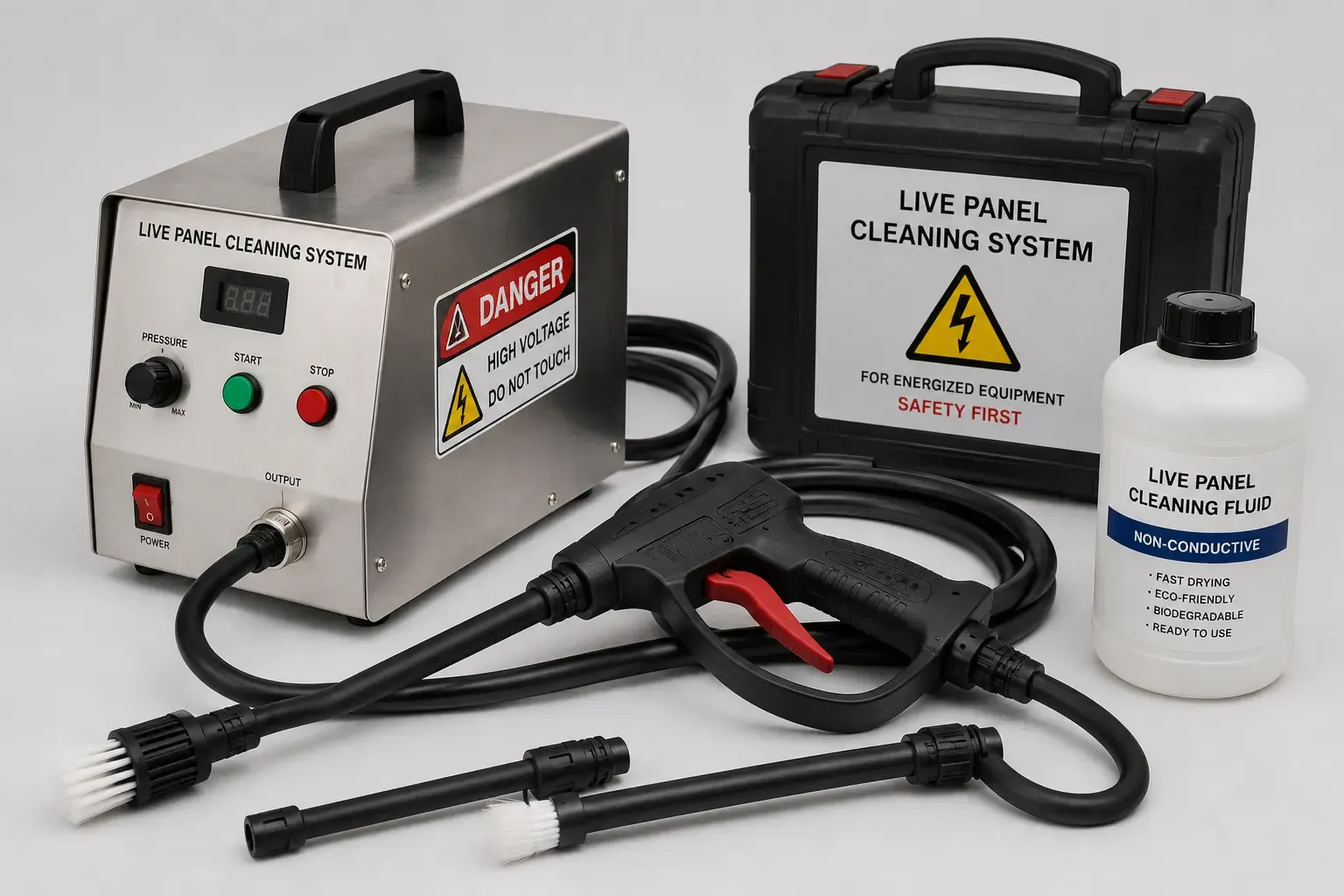
Non-conductive cleaning technology resolves this conflict directly. Cleaning using specialized, non-conductive cleaning agents and advanced tools designed specifically for energized equipment allows thorough cleaning to happen without compromising safety or requiring a shutdown.
How Dry Ice Blasting Actually Works
The most widely used method for safely cleaning live electrical equipment is dry ice, or CO2 pellet, blasting. The technique works through a specific physical process:
- Solid CO2 pellets, roughly the size of salt granules, are propelled through an insulated wand at controlled pressure toward the contaminated surface
- On impact, the pellets sublimate instantly, transitioning directly from solid to gas and expanding rapidly, roughly 400-fold in volume
- This sudden expansion creates a shearing and lifting force that separates contaminants from the equipment surface without requiring abrasive contact
- The dislodged contaminant falls away or is drawn out of the enclosure, while the CO2 gas itself simply disperses into the atmosphere as a naturally occurring compound
- No moisture, residue, or secondary waste is left behind, since the entire process is dry and the only byproduct is the contaminant itself and CO2 gas
This process is inherently non-conductive, non-abrasive, and leaves no conductive residue, which is precisely why it's suited to electrical maintenance on live or sensitive installations in a way that water or solvent-based methods simply cannot match.
Why CO2 Pellets Are Safe on Energized Equipment
CO2 pellets carry a dielectric constant roughly equivalent to dry air, meaning they don't conduct electricity even when used directly on energized components. This property is fundamental to the entire live cleaning approach: because the cleaning medium itself doesn't conduct, and because it leaves no conductive residue behind, contaminants can be removed from busbars, breaker compartments, and switchgear internals without introducing the shock or arc-flash risk that water-based cleaning would create on the same energized equipment.
It's worth being clear that non-conductive doesn't automatically mean risk-free. Incorrect stand-off distances, unexpected faults, or disturbed debris can still create hazards during the process, which is exactly why live cleaning work should always be performed by trained technicians following proper electrical safety protocols, with the final decision on whether a specific panel can be safely cleaned live resting with a qualified electrical authority and site safety team.
What Equipment Can Be Cleaned Using This Method
Live panel cleaning commonly applies to a wide range of electrical equipment types:
- Low and medium-voltage distribution boards and panels, including cabinets, busbars, and internal frames
- Switchgear, both air-insulated and gas-insulated designs, covering breaker compartments and external surfaces
- Motor control centers, including compartments, busbars, and wiring channels
- Transformer enclosures, removing external grime, salt deposits, and soot buildup
- Generator sets, covering engine bays, alternator cooling fins, and control compartments
- Substations, including outdoor switchgear and associated structural components
Whether a specific piece of energized equipment is suitable for live cleaning depends on engineering review, the equipment's specific voltage rating and condition, and sign-off from a competent electrical authority, rather than being automatically appropriate for every installation without assessment.
Industries That Benefit Most From Live Panel Cleaning
Industries significantly benefiting from live panel cleaning include operations where any planned shutdown carries substantial cost or operational risk:
Oil and Gas
Ensuring uninterrupted operations in critical facilities where a planned electrical shutdown for maintenance could disrupt continuous process operations that are expensive or complex to restart.
Manufacturing
Production facilities running continuous processes where scheduled downtime for cleaning would directly translate into lost production output.
Data Centers and Critical Infrastructure
Facilities where power continuity is fundamental to the service being provided, making even brief planned outages for routine maintenance genuinely costly.
Commercial and Facilities Management
Buildings and complexes where electrical maintenance needs to happen without disrupting tenant operations or building services.
Preventive Maintenance vs Reactive Cleaning
Live panel cleaning works best as part of a scheduled preventive maintenance program rather than a reactive response after visible contamination or an actual incident. Building regular cleaning into a facility's reliability-centered maintenance approach increases equipment lifespan, improves cooling efficiency in enclosures where dust buildup affects thermal performance, and reduces the risk of unplanned failures that carry far higher cost than a scheduled cleaning visit ever would.
What to Expect From a Professional Live Panel Cleaning Service
A properly delivered live panel cleaning service should include:
- Trained technicians experienced specifically in energized equipment cleaning, not general industrial cleaning work
- An engineering and safety review confirming the specific equipment is suitable for live cleaning before work begins
- Proper non-conductive equipment and technique matched to the panel's voltage rating and configuration
- Documentation of the work performed, useful for tracking maintenance history and demonstrating due diligence in electrical safety compliance
- Minimal disruption to facility operations, since avoiding a shutdown is the entire point of the service
General Tech Services provides live panel cleaning services across UAE industries including oil and gas, using specialized non-conductive cleaning agents and tools designed specifically for energized equipment, delivering thorough cleaning without compromising safety or operational continuity.
Frequently Asked Questions
Is it actually safe to clean electrical panels while they're still energized? Yes, when performed correctly using non-conductive methods like dry ice blasting, by trained technicians, and following proper engineering review and safety sign-off for the specific equipment involved. The process itself uses a non-conductive medium that leaves no residue, but correct technique and safety protocols remain essential.
What contaminants does live panel cleaning actually remove? Dust, dirt, salt spray, soot, and general grime that accumulate inside electrical enclosures over time, all of which can compromise insulation and increase the risk of tracking or flashover if left unaddressed.
How often should live panel cleaning be performed? This depends on the specific environment, facilities in dusty, coastal, or industrial settings generally need more frequent cleaning than those in cleaner, climate-controlled environments. A reliability-centered maintenance schedule tailored to your facility's actual conditions is more effective than a single fixed interval applied universally.
Can any energized equipment be cleaned using this method? Not automatically. Suitability depends on engineering review, the equipment's voltage rating and condition, and sign-off from a qualified electrical authority. Some equipment configurations may require de-energized cleaning instead, depending on the specific risk assessment.
Does dry ice blasting leave any residue behind? No. The CO2 pellets sublimate directly from solid to gas on impact, leaving no moisture, chemical residue, or secondary waste behind, which is part of why the method is well suited to sensitive electrical components.
Closing Thoughts
Live panel cleaning UAE oil and gas, manufacturing, and critical infrastructure facilities rely on solves a genuine operational conflict: keeping electrical equipment clean and safe without forcing a costly shutdown to do it. Using non-conductive dry ice blasting technology, performed by trained technicians following proper safety review, contamination that would otherwise silently compromise insulation and increase flashover risk gets removed without disrupting the continuous operations these facilities depend on.
To schedule live panel cleaning or discuss a preventive maintenance program for your facility's electrical equipment, reach out through the General Tech Services contact page, or explore the full range of services covering electrical safety, calibration, and engineering solutions across the UAE.