Noise is one of the few workplace hazards that damages people gradually, quietly, and often without anyone noticing until the harm is already done. That's exactly why regulators take sound level measurement seriously, and why the instrument doing that measurement needs to be provably accurate. A sound level meter reading even a couple of decibels off can mean a genuinely hazardous work environment gets certified as compliant, or a construction site gets flagged for a violation it never actually committed.
This is why sound level meter calibration UAE construction sites, industrial facilities, and environmental monitoring programs depend on needs to follow recognized international standards, not an informal check against another handheld unit. This guide covers how sound level meter calibration actually works, the standards governing it, and what UAE noise compliance actually requires.
Why Decibels Are Deceptively Easy to Get Wrong
The decibel scale is logarithmic, not linear, which means small numerical errors represent disproportionately large real-world differences in sound energy. A sound level meter reading that has drifted by even a few decibels can significantly misrepresent actual noise exposure, which matters enormously given how noise regulations are typically structured around specific threshold values rather than general ranges.
Sound level meters are also mechanically and electronically sensitive instruments. The microphone and measurement chain can drift due to temperature stress, humidity, and the everyday knocks and vibration that come with regular fieldwork, meaning an instrument that seemed perfectly accurate on its last calibration date can have quietly drifted by the time it's actually needed for a compliance measurement months later.
What Sound Calibration Actually Covers
Sound calibration is the process of verifying and adjusting sound level meters, noise dosimeters, and acoustic measurement devices to ensure accurate sound level readings. A proper calibration process addresses the full measurement chain, not just a single reference tone check, and typically verifies:
- Microphone sensitivity at a reference frequency, most commonly 1 kHz
- Frequency weighting accuracy across A, C, and Z weighting curves, since sound level meters apply different filtering depending on which weighting is selected for a given measurement type
- Time weighting response, covering Fast, Slow, and Impulse settings used for different measurement scenarios
- Level linearity across the instrument's measurement range, confirming accuracy holds consistently rather than only at one reference point
- Overall system response, including the microphone, preamplifier, and measurement electronics working together as a complete chain
How the Calibration Process Actually Works
A proper laboratory calibration generally follows this sequence:
- Visual inspection of the microphone, windscreen, casing, and controls for physical damage or contamination
- Verification that frequency and time weighting selections function correctly on the instrument
- Thermal stabilization, allowing the instrument to acclimate to the calibration environment, since temperature-dependent drift in the microphone and electronics can otherwise introduce measurement errors
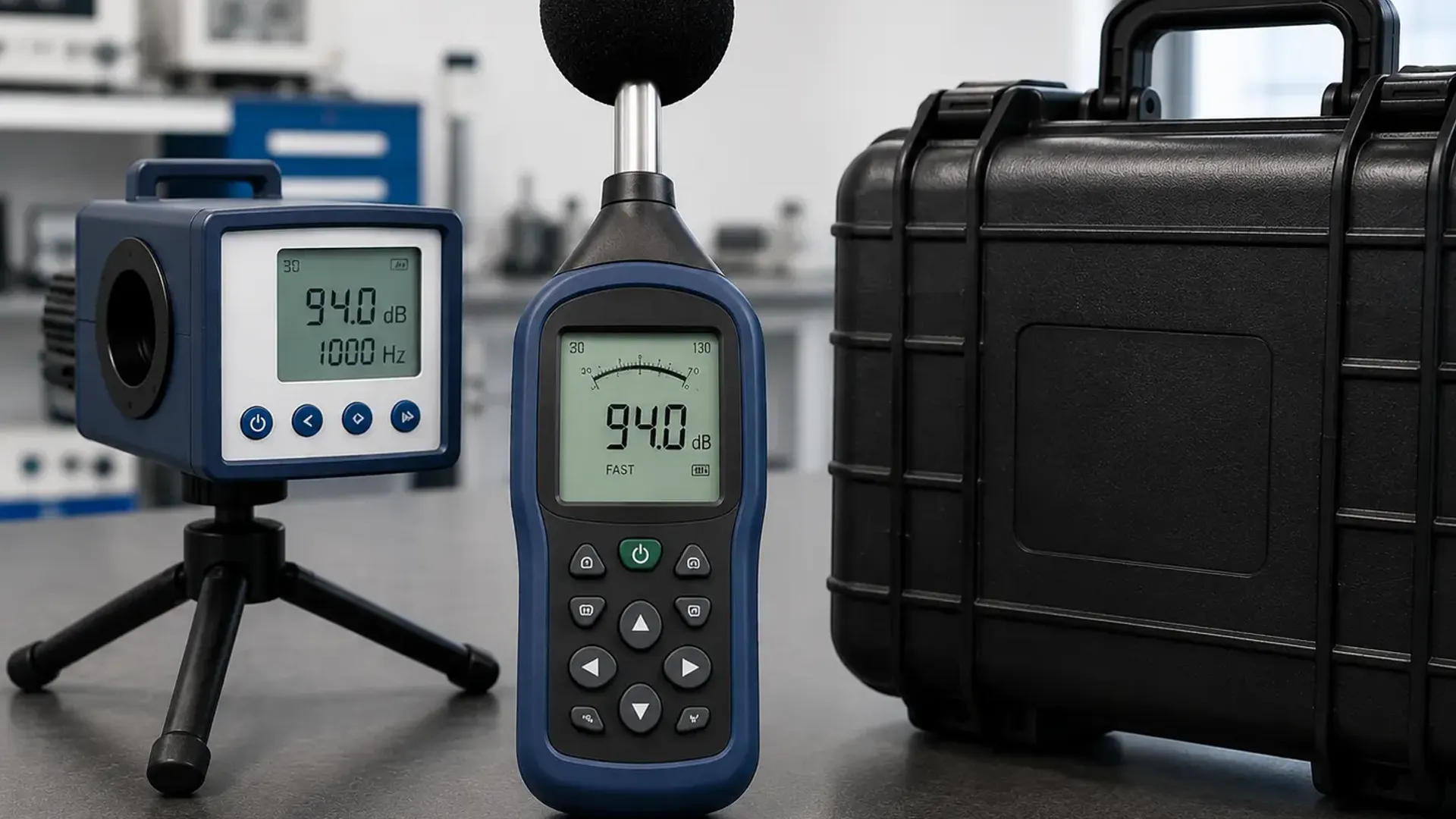
- Acoustic calibrator verification, using a certified reference source, commonly generating a stable 94 dB tone at 1 kHz via a pistonphone-style calibrator, applied directly over the microphone
- Frequency response testing across the instrument's rated range to confirm the A, C, and Z weighting curves perform within tolerance
- Documentation of as-found and as-left readings, particularly important if any adjustment was required during the process
Proper acoustical coupling between the calibrator and the microphone matters more than it might seem. An improperly sealed connection can create air leaks around the microphone housing, introducing low-frequency response errors that would otherwise be mistaken for a genuine instrument fault.
Sound Level Meter Classes: Class 1 vs Class 2
Sound level meters are graded into accuracy classes under international standards, and understanding which class your work requires matters both for equipment selection and for interpreting calibration results correctly:
Class 1 instruments represent the precision grade, suited to laboratory work, environmental applications, building acoustics assessments, and detailed traffic or industrial noise studies where tighter accuracy is required.
Class 2 instruments are the general-purpose grade, commonly used for workplace noise assessment, basic environmental monitoring, entertainment venue noise checks, and general construction or vehicle noise measurement, where a wider but still defensible tolerance is acceptable.
Selecting the correct class for your application matters as much as the calibration itself, since using a Class 2 instrument for work genuinely requiring Class 1 precision undermines measurement confidence regardless of how well that Class 2 unit was calibrated.
Standards Governing Sound Level Meter Calibration
Calibration ensures compliance with ISO 17025, ANSI S1.4, and IEC 61672, the primary international standards governing sound level meter performance and calibration methodology. IEC 61672 in particular defines the electroacoustical performance specifications for sound level meters, the required frequency weighting characteristics, and the testing methodology laboratories use to verify conformance. Working to these standards ensures calibration results are consistent and comparable regardless of which laboratory performs the work or which brand of meter is being tested.
UAE Noise Compliance: What Regulators Actually Require
Sound level meter calibration ties directly into specific UAE regulatory frameworks that facilities need to demonstrate compliance against:
- Dubai Municipality noise regulations, governing permissible noise levels across construction, industrial, and commercial activity
- Abu Dhabi EHSMS, the Environment, Health and Safety Management System framework applied across Abu Dhabi's industrial and construction sectors
- ISO noise exposure limits, referenced in workplace occupational health and safety programs across the wider UAE
In the UAE, sound calibration is essential for construction sites, oil and gas industries, aviation, entertainment venues, and workplace noise monitoring, since accurate measurement data is what regulators, auditors, and internal health and safety teams rely on to confirm activities remain within permitted noise limits. Proper calibration protects facilities from preventable regulatory fines while also genuinely protecting worker hearing health, which is the underlying purpose these regulations exist to serve in the first place.
Noise Dosimeters and Workplace Exposure Monitoring
Beyond standalone sound level meters, many facilities also rely on noise dosimeters, wearable devices that track an individual worker's cumulative noise exposure across a full shift. These instruments require the same rigorous calibration approach as sound level meters, since occupational noise exposure calculations feed directly into legal exposure limit compliance and hearing conservation program decisions. A dosimeter that has drifted out of calibration can understate a worker's actual exposure, delaying the protective interventions that exposure data is specifically meant to trigger.
ISO 17025 Accredited Sound Calibration
Our sound calibration services cover sound level meters, noise dosimeters, and acoustic measurement devices under full EIAC ISO 17025 accreditation, supporting compliance with ANSI S1.4, IEC 61672, and UAE noise regulations across Dubai, Abu Dhabi, Sharjah, Ajman, Ras Al Khaimah, Fujairah, and Umm Al Quwain.
What a Sound Level Meter Calibration Certificate Should Include
A properly issued calibration certificate should clearly document:
- The specific instrument make, model, and serial number, along with the acoustic calibrator used as reference
- Microphone sensitivity results at the reference frequency
- Frequency and time weighting verification results
- As-found and as-left data if any adjustment was performed
- The instrument's accuracy class and applicable tolerance
- The accreditation body and standard the issuing laboratory operates under
How Often Should Sound Level Meters Be Calibrated
General guidance for calibration frequency includes:
- Annual laboratory calibration as a standard baseline, aligning with most regulatory and manufacturer recommendations
- Field verification using an acoustic calibrator before and after each measurement session, regardless of how recently the full laboratory calibration was performed
- Immediate recalibration after any physical shock, drop, or exposure to extreme environmental conditions
- More frequent calibration for instruments used continuously in harsh field environments, such as active construction sites
Frequently Asked Questions
What is the difference between field calibration and full laboratory calibration? Field calibration uses a handheld acoustic calibrator to verify the instrument's sensitivity before and after each measurement session, confirming it's still reading correctly at a single reference point. Full laboratory calibration is a more comprehensive process verifying frequency response, weighting accuracy, and linearity across the instrument's full range against traceable reference standards.
What is the difference between Class 1 and Class 2 sound level meters? Class 1 meters offer tighter accuracy suited to precision laboratory and detailed environmental work, while Class 2 meters offer a wider but still defensible tolerance suited to general workplace and environmental noise monitoring. The correct class depends on what your specific application or regulation requires.
How often should a sound level meter be sent for laboratory calibration? Most manufacturers and regulatory frameworks recommend annual laboratory calibration, in addition to field verification using an acoustic calibrator before and after each individual measurement session.
Why does UAE noise compliance require calibrated equipment specifically? Regulatory frameworks like Dubai Municipality noise regulations and Abu Dhabi EHSMS rely on accurate measurement data to determine compliance. An uncalibrated instrument's readings cannot be defensibly relied upon during an audit or regulatory review, regardless of what the display shows.
Do noise dosimeters need the same calibration process as sound level meters? Yes. Noise dosimeters rely on the same underlying acoustic measurement principles and require equivalent calibration rigor, since their cumulative exposure readings directly inform occupational hearing conservation and legal exposure limit compliance decisions.
Closing Thoughts
Sound level meter calibration UAE construction, industrial, and environmental compliance programs depend on protects something that matters well beyond paperwork: genuine worker hearing health and environmental noise accountability. Calibration performed to IEC 61672 and ANSI S1.4, backed by proper traceability, is what keeps every noise compliance measurement, and every decision built on top of it, defensible.
To schedule sound level meter or broader acoustic calibration across the UAE, reach out through the General Tech Services contact page, or explore the full range of ISO 17025 accredited calibration disciplines covering sound, electrical, pressure, and temperature measurement.